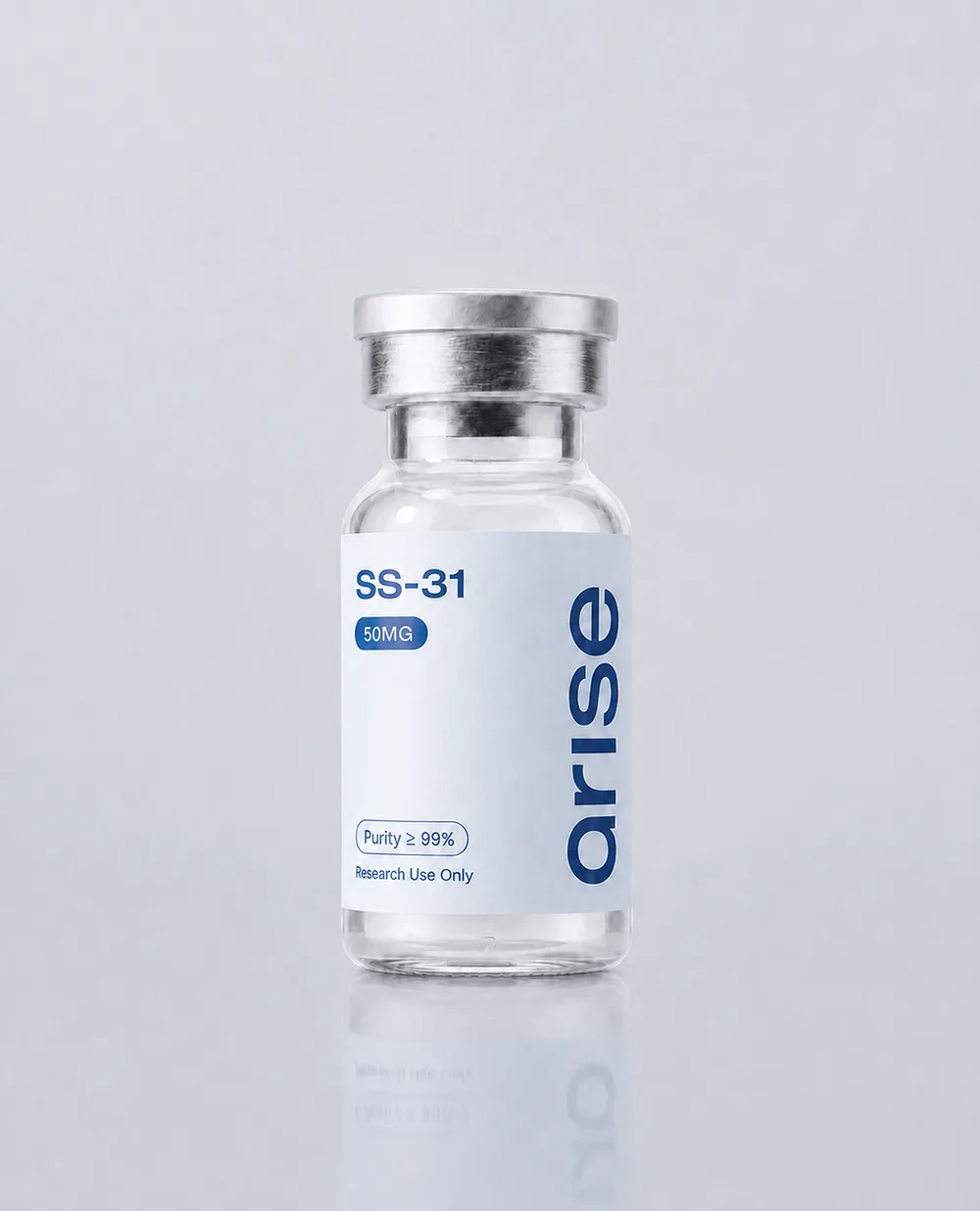
SS-31
50MGElamipretide, mitochondria-targeted tetrapeptide.
6 peer-reviewed citations for this compound
Read the sourcesVolume tiers count vials of this compound at this strength. Mixing different compounds does not combine toward a tier.
- ≥99% purity specification
- Secure checkout
- Ships in 1 business day
- Research use only
Released against a ≥99% HPLC purity specification and supplied as a sealed laboratory reagent for in vitro research use only.
- Type
- Elamipretide — mitochondria-targeted tetrapeptide
- CAS number
- 736992-21-5
- Molecular formula
- C32H49N9O5
- Molecular weight
- 639.79 g/mol
- Amino acids
- 4
- Form
- Lyophilized powder
- Vial strength
- 50MG
- Purity specification
- ≥99% by HPLC
Identifiers are published properties of the molecule. Values we cannot confirm are omitted rather than estimated.
Dispatch
Ships within 1 business day of order confirmation, from the US. Vials ship lyophilized at ambient temperature; move them to the storage condition below on arrival.
Lyophilized
Store at -20°C, protected from light. Stable 24+ months sealed.
Reconstituted
Store at 2-8°C. Use within approximately 30 days.
How SS-31 is described to act.
Elamipretide (SS-31, MTP-131, Bendavia) is a cell-permeable aromatic-cationic tetrapeptide that accumulates in the inner mitochondrial membrane and binds cardiolipin. This binding is reported to stabilize cristae architecture and the cardiolipin-cytochrome c supercomplex, lowering reactive oxygen species generation and supporting oxidative phosphorylation. Work in aged mouse skeletal muscle mitochondria reports direct interaction with the adenine nucleotide translocator (ANT), increasing ADP uptake and restoring ADP sensitivity without altering the abundance of ADP/ATP transport and synthesis proteins. Shotgun proteomic analyses in mouse heart attribute part of the effect to reversal of age-associated cysteine S-glutathionylation, including on ANT.
Mechanistic descriptions summarize published in vitro and animal work. They are not a representation of efficacy or safety in any subject, and no administration guidance is given or implied.
MMPOWER-3 was a phase 3 randomized, double-blind, placebo-controlled trial in which participants with genetically confirmed primary mitochondrial myopathy received 24 weeks of subcutaneous elamipretide or placebo, with co-primary endpoints of change from baseline in 6-minute walk test distance and total fatigue on the Primary Mitochondrial Myopathy Symptom Assessment. In Barth syndrome, the 168-week open-label extension of the TAZPOWER trial had safety and tolerability as its primary endpoints, reported injection-site reactions as the most common adverse event among the ten patients who entered, and tracked 6-minute walk distance, muscle strength, echocardiographic parameters, and cardiolipin and monolysocardiolipin biomarkers. In preclinical geroscience work, eight weeks of elamipretide reversed nearly all of the age-associated increase in cardiac protein S-glutathionylation in 24-month-old mice, and a separate study reported that ADP sensitivity of aged mouse muscle mitochondria is rapidly modifiable via ANT. Reviews in this set summarize preclinical models spanning heart failure, ischemia-reperfusion injury, neurodegeneration, metabolic syndrome and muscle atrophy, including canine heart-failure work examining left ventricular ejection fraction. These citations describe endpoints measured in defined patient populations and animal models and do not generalize beyond them.
Sources & references
Cited literature is provided for scientific reference only and does not constitute a representation of efficacy or safety in any subject. All research findings presented are sourced from peer-reviewed journals and are provided for educational reference only.
- 01Elamipretide: A Review of Its Structure, Mechanism of Action, and Therapeutic Potential
Tung C, et al. · Int J Mol Sci, 2025
- 02
- 03
- 04
- 05Targeting mitochondrial dysfunction with elamipretide
Obi C, et al. · Heart Fail Rev, 2022
- 06Elamipretide (SS-31) treatment attenuates age-associated post-translational modifications of heart proteins
Whitson JA, et al. · Geroscience, 2021
Every entry links to its record at the publisher or on PubMed. Titles are reproduced exactly as published.
Further searches
Live database searches for SS-31, run against the current index and retrieved independently of this site.
Bench handling, not a dosing guide.
Intended use
Supplied exclusively as a research reagent for in vitro and laboratory use by qualified researchers. Not a drug, dietary supplement, cosmetic or medical device, and not for human or veterinary use. No dosing, route or administration guidance is provided for any compound in this catalog.
Personal protection
Handle in a controlled laboratory environment with gloves and eye protection. Avoid generating or inhaling airborne particulate when opening a vial, and do not handle the material outside a designated work area.
Opening and reconstitution
Lyophilized peptides are hygroscopic. Let the sealed vial equilibrate to room temperature before opening so atmospheric moisture does not condense onto the powder. Reconstitute by directing diluent down the vial wall and swirling until dissolved — do not shake, which shears and foams the peptide.
Stability and aliquoting
Store at -20°C, protected from light. Stable 24+ months sealed. Store at 2-8°C. Use within approximately 30 days. Aliquot reconstituted material and minimize repeated freeze-thaw cycles.
Waste disposal
Dispose of unused material, reconstituted solutions and sharps through your institution's chemical and biological waste stream, in accordance with local regulations. Do not dispose of research material in domestic waste or to drain.
Others in longevity & cellular
Epithalon
Synthetic tetrapeptide Ala-Glu-Asp-Gly.
FOXO4
FOXO4-p53 interfering peptide, D-retro-inverso.
Glutathione
Reduced L-glutathione tripeptide.
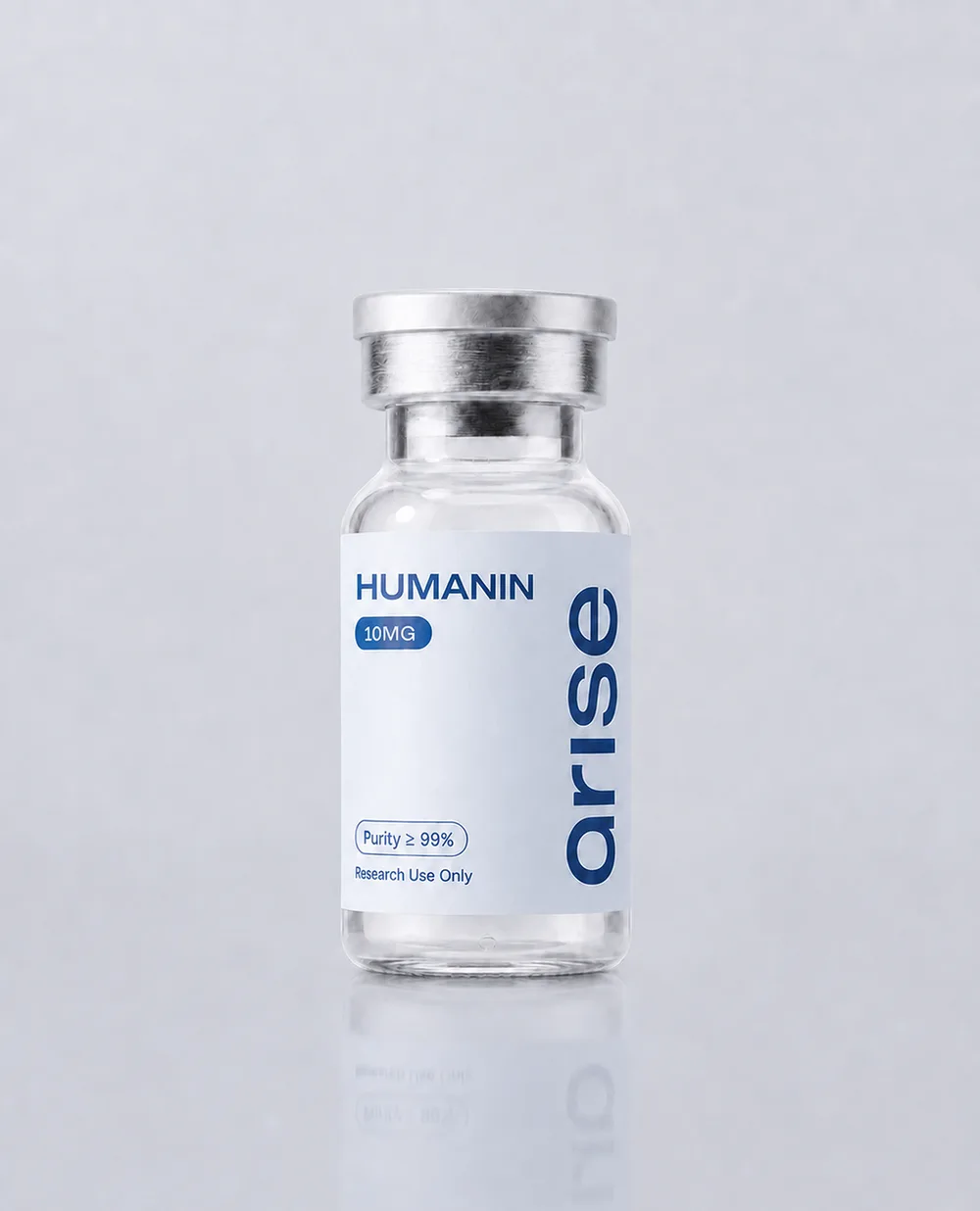
Humanin
24-residue mitochondrial-derived peptide.
Important research notice
Not for human consumption. This product is sold exclusively for research and educational purposes. It is not intended to diagnose, treat, cure, or prevent any disease.
This material is supplied exclusively as a research reagent for in vitro and laboratory use by qualified researchers. It is not a drug, dietary supplement, cosmetic, or medical device, is not intended for human or veterinary use, and is not intended to diagnose, treat, cure, or prevent any disease. No dosing, administration, therapeutic, or benefit claims are made or implied. Cited literature is provided for scientific reference only and does not constitute a representation of efficacy or safety in any subject.
By purchasing this product, you confirm that you are a qualified researcher and will use it in accordance with all applicable laws and regulations.