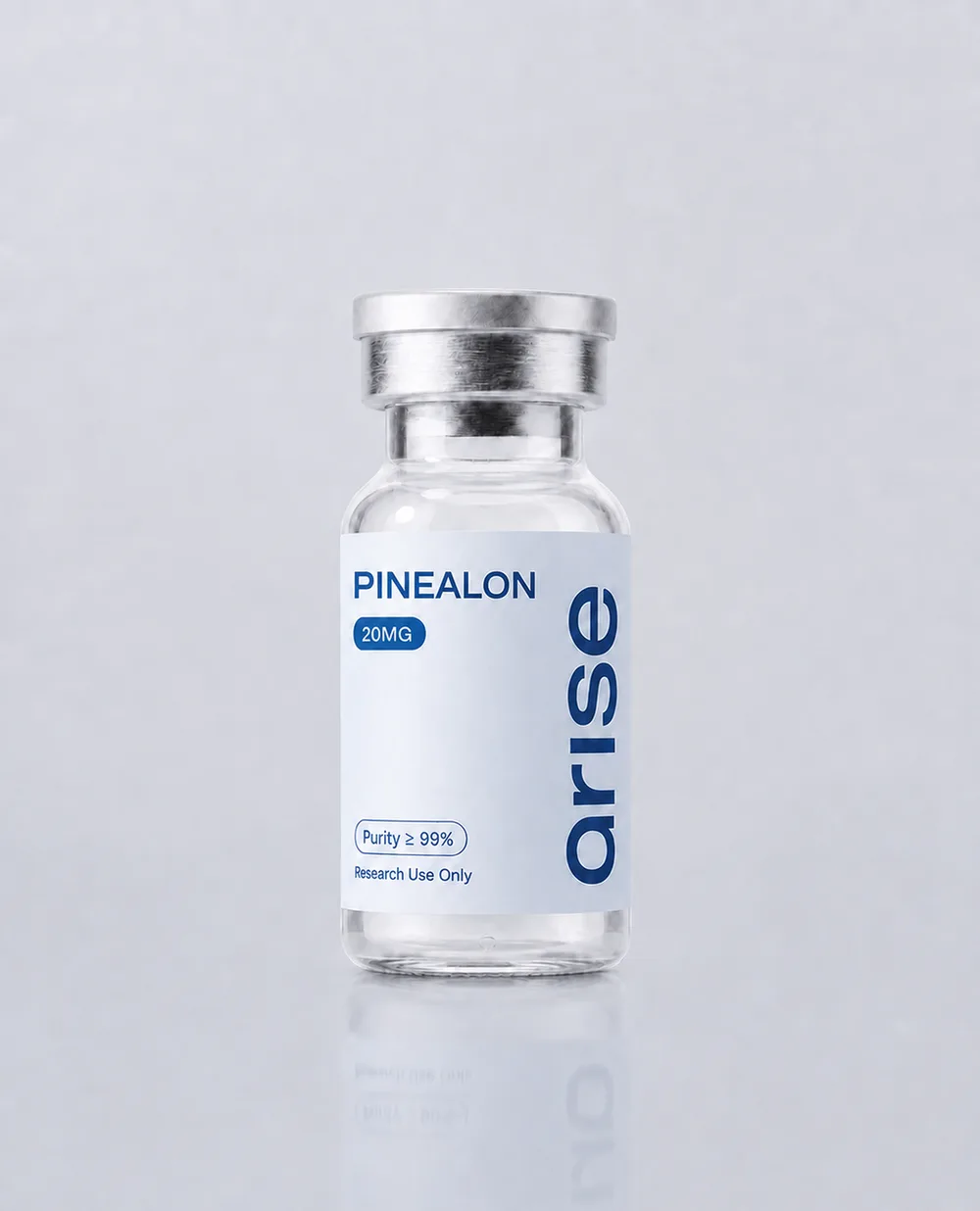
Pinealon
20MGSynthetic tripeptide Glu-Asp-Arg.
6 peer-reviewed citations for this compound
Read the sourcesVolume tiers count vials of this compound at this strength. Mixing different compounds does not combine toward a tier.
- ≥99% purity specification
- Secure checkout
- Ships in 1 business day
- Research use only
Released against a ≥99% HPLC purity specification and supplied as a sealed laboratory reagent for in vitro research use only.
- Type
- Synthetic tripeptide
- Amino acids
- 3
- Sequence
- Glu-Asp-Arg
- Form
- Lyophilized powder
- Vial strength
- 20MG
- Purity specification
- ≥99% by HPLC
Identifiers are published properties of the molecule. Values we cannot confirm are omitted rather than estimated.
Dispatch
Ships within 1 business day of order confirmation, from the US. Vials ship lyophilized at ambient temperature; move them to the storage condition below on arrival.
Lyophilized
Store at -20°C, protected from light. Stable 24+ months sealed.
Reconstituted
Store at 2-8°C. Use within approximately 30 days.
How Pinealon is described to act.
Pinealon is the synthetic tripeptide Glu-Asp-Arg (EDR). Fluorescence studies show FITC-labelled EDR reaching the cytoplasm, nucleus and nucleolus of HeLa cells and binding single- and double-stranded deoxyribooligonucleotides with a selectivity that discriminates nucleotide sequence and cytosine methylation status, with preference for CNG-containing sites. Biophysical analysis by spectroscopy, NMR, viscosimetry and molecular dynamics indicates that EDR partly penetrates the major groove of DNA and contacts base atoms, mainly the N7 and O6 of guanine, an interaction promoted by Mg2+ screening of the DNA phosphate charge. EDR also binds site-specifically to the N-terminal tails of histones H1, H2B, H3 and H4, which has been proposed as an epigenetic mechanism of gene regulation; review-level work further describes modulation of the MAPK/ERK pathway and of transcripts including caspase-3, p53, SOD2, GPX1, PPARA and PPARG in in vitro and in vivo models.
Mechanistic descriptions summarize published in vitro and animal work. They are not a representation of efficacy or safety in any subject, and no administration guidance is given or implied.
In cerebellar granule cells, neutrophils and PC12 cells, EDR produced dose-dependent restriction of reactive oxygen species accumulation induced by receptor-dependent and receptor-independent oxidative stress and decreased necrotic cell death, accompanied by a delayed time course of ERK1/2 activation and modification of the cell cycle. Because ROS restriction and reduced cell mortality saturated at lower concentrations than cell-cycle modulation, the authors inferred a direct interaction with the cell genome in addition to antioxidant activity. In aging cultures of brain cortex cells, EDR stimulated serotonin expression, and molecular docking identified a complementary CCTGCC sequence in the 5-tryptophan hydroxylase gene, supporting an epigenetic route to regulation of serotonin synthesis. Fluorescence-quenching experiments with wheat histones established that peptide binding to histones and to histone-deoxyribooligonucleotide complexes is site specific and sensitive to methylation state, and that bound DNA can enhance or inhibit peptide binding. A review of the EDR literature reports neuroprotective effects in neuronal cultures derived from mouse models of Alzheimer's and Huntington's disease, including interference with dendritic spine elimination, and activation of antioxidant enzyme synthesis in rat cerebellar neuron cultures.
Sources & references
Cited literature is provided for scientific reference only and does not constitute a representation of efficacy or safety in any subject. All research findings presented are sourced from peer-reviewed journals and are provided for educational reference only.
- 01
- 02Role of Mono- and Divalent Ions in Peptide Glu-Asp-Arg-DNA Interaction
Silanteva IA, et al. · J Phys Chem B, 2019
- 03Short peptides stimulate serotonin expression in cells of brain cortex
Khavinson VKh, et al. · Bull Exp Biol Med, 2014
- 04Interaction of short peptides with FITC-labeled wheat histones and their complexes with deoxyribooligonucleotides
Fedoreyeva LI, et al. · Biochemistry (Mosc), 2013
- 05
- 06Pinealon increases cell viability by suppression of free radical levels and activating proliferative processes
Khavinson V, et al. · Rejuvenation Res, 2011
Every entry links to its record at the publisher or on PubMed. Titles are reproduced exactly as published.
Further searches
Live database searches for Pinealon, run against the current index and retrieved independently of this site.
Bench handling, not a dosing guide.
Intended use
Supplied exclusively as a research reagent for in vitro and laboratory use by qualified researchers. Not a drug, dietary supplement, cosmetic or medical device, and not for human or veterinary use. No dosing, route or administration guidance is provided for any compound in this catalog.
Personal protection
Handle in a controlled laboratory environment with gloves and eye protection. Avoid generating or inhaling airborne particulate when opening a vial, and do not handle the material outside a designated work area.
Opening and reconstitution
Lyophilized peptides are hygroscopic. Let the sealed vial equilibrate to room temperature before opening so atmospheric moisture does not condense onto the powder. Reconstitute by directing diluent down the vial wall and swirling until dissolved — do not shake, which shears and foams the peptide.
Stability and aliquoting
Store at -20°C, protected from light. Stable 24+ months sealed. Store at 2-8°C. Use within approximately 30 days. Aliquot reconstituted material and minimize repeated freeze-thaw cycles.
Waste disposal
Dispose of unused material, reconstituted solutions and sharps through your institution's chemical and biological waste stream, in accordance with local regulations. Do not dispose of research material in domestic waste or to drain.
Others in longevity & cellular
Epithalon
Synthetic tetrapeptide Ala-Glu-Asp-Gly.
FOXO4
FOXO4-p53 interfering peptide, D-retro-inverso.
Glutathione
Reduced L-glutathione tripeptide.
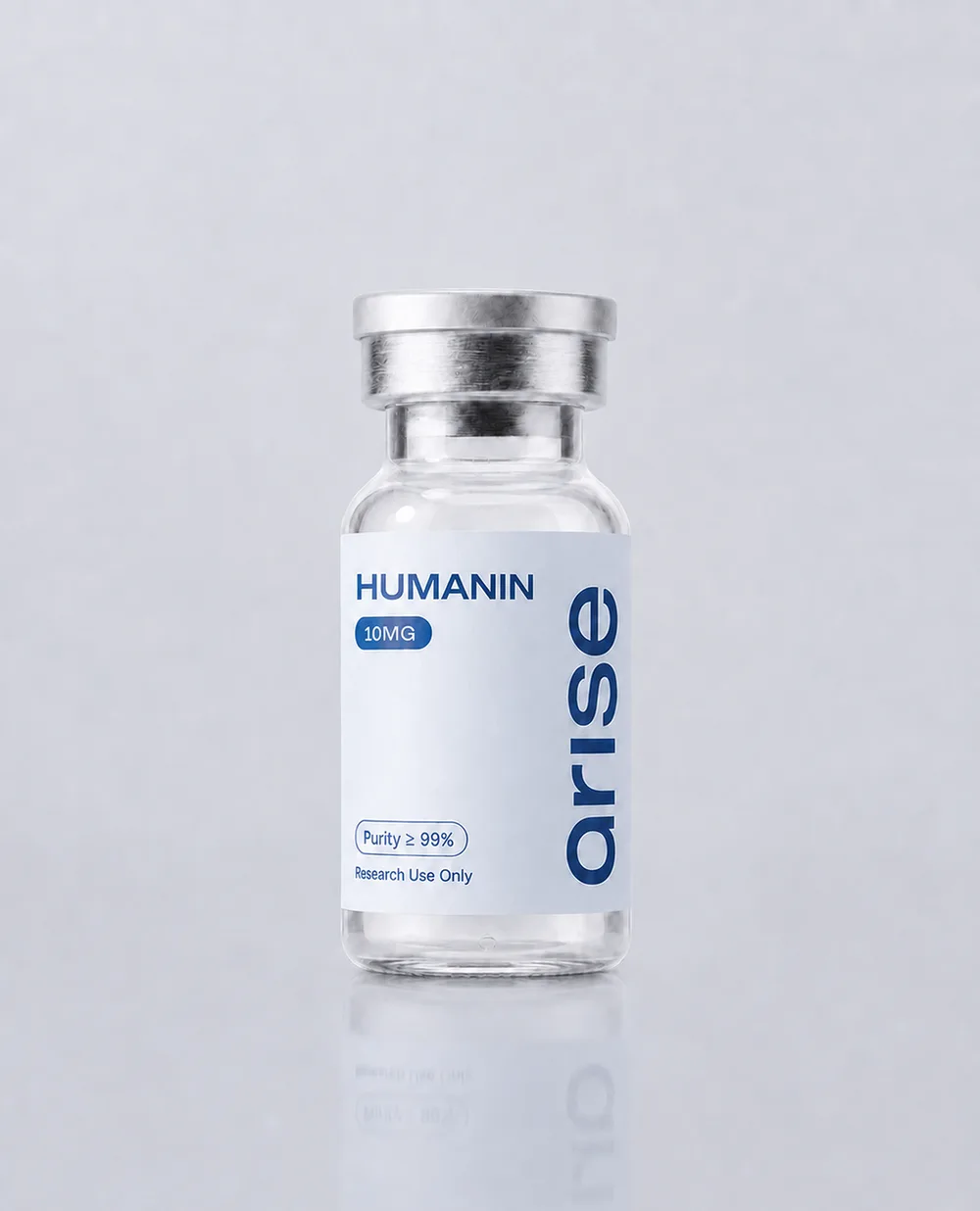
Humanin
24-residue mitochondrial-derived peptide.
Important research notice
Not for human consumption. This product is sold exclusively for research and educational purposes. It is not intended to diagnose, treat, cure, or prevent any disease.
This material is supplied exclusively as a research reagent for in vitro and laboratory use by qualified researchers. It is not a drug, dietary supplement, cosmetic, or medical device, is not intended for human or veterinary use, and is not intended to diagnose, treat, cure, or prevent any disease. No dosing, administration, therapeutic, or benefit claims are made or implied. Cited literature is provided for scientific reference only and does not constitute a representation of efficacy or safety in any subject.
By purchasing this product, you confirm that you are a qualified researcher and will use it in accordance with all applicable laws and regulations.