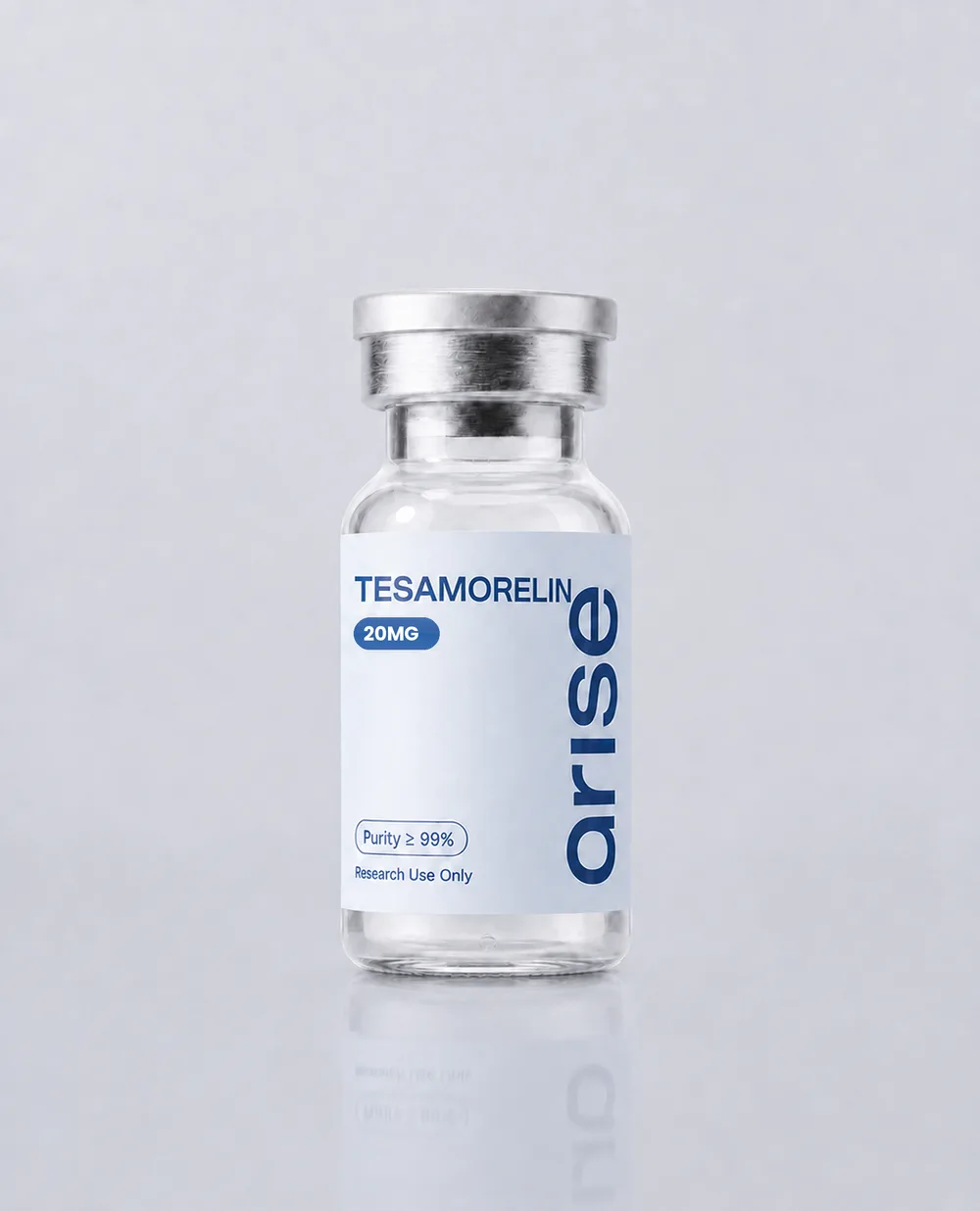
Tesamorelin
20MGTrans-3-hexenoyl GHRH (1-44) analog.
6 peer-reviewed citations for this compound
Read the sourcesVolume tiers count vials of this compound at this strength. Mixing different compounds does not combine toward a tier.
- ≥99% purity specification
- Secure checkout
- Ships in 1 business day
- Research use only
Released against a ≥99% HPLC purity specification and supplied as a sealed laboratory reagent for in vitro research use only.
- Type
- Trans-3-hexenoyl GHRH (1-44) analog
- CAS number
- 218949-48-5
- Molecular formula
- C221H366N72O67S
- Molecular weight
- 5135.9 g/mol
- Amino acids
- 44
- Form
- Lyophilized powder
- Vial strength
- 20MG
- Purity specification
- ≥99% by HPLC
Identifiers are published properties of the molecule. Values we cannot confirm are omitted rather than estimated.
Dispatch
Ships within 1 business day of order confirmation, from the US. Vials ship lyophilized at ambient temperature; move them to the storage condition below on arrival.
Lyophilized
Store at -20°C, protected from light. Stable 24+ months sealed.
Reconstituted
Store at 2-8°C. Use within approximately 30 days.
How Tesamorelin is described to act.
Tesamorelin is a synthetic analog of human growth hormone-releasing factor (GRF) that binds the GHRH receptor on pituitary somatotrophs and increases both basal and pulsatile growth hormone secretion, with a downstream rise in IGF-1. Population pharmacokinetic modeling in HIV-infected patients and healthy subjects described the disposition with an open one-compartment model featuring first- and zero-order absorption and first-order elimination, estimating plasma clearance near 1,060 L/h and volume of distribution near 200 L. Hepatic transcriptomic analysis of paired liver biopsies from a randomized trial reported increased expression of gene sets involved in oxidative phosphorylation and decreased expression of gene sets associated with inflammation, tissue repair, and cell division. The literature frames these changes as a mechanistic window on pulsatile growth hormone action.
Mechanistic descriptions summarize published in vitro and animal work. They are not a representation of efficacy or safety in any subject, and no administration guidance is given or implied.
Tesamorelin is the most extensively developed compound in this group and was approved by the US Food and Drug Administration in November 2010 for reduction of excess abdominal fat in HIV-infected patients with lipodystrophy. Two 26-week randomized trials reviewed in Drugs used visceral adipose tissue as the primary measure, with trunk fat, waist circumference, and body image parameters as secondary measures; the review reports that visceral adipose tissue reaccumulated after therapy was discontinued during the 52-week extension phases. A randomized, double-blind, multicentre trial in 61 people with HIV and non-alcoholic fatty liver disease (NCT02196831) set change in hepatic fat fraction by proton magnetic resonance spectroscopy over 12 months as its primary endpoint and plasma glucose as its primary safety endpoint. Paired liver biopsy specimens from that trial were subsequently used for gene set enrichment analysis. Population pharmacokinetics were characterized in 38 HIV-infected patients and healthy subjects receiving subcutaneous doses of 1 or 2 mg for 14 consecutive days, and age, body size, race, and health status were not related to pharmacokinetic parameters across the range studied.
Sources & references
Cited literature is provided for scientific reference only and does not constitute a representation of efficacy or safety in any subject. All research findings presented are sourced from peer-reviewed journals and are provided for educational reference only.
- 01Effects of tesamorelin on hepatic transcriptomic signatures in HIV-associated NAFLD
Fourman LT, et al. · JCI Insight, 2020
- 02
- 03Population pharmacokinetic analysis of tesamorelin in HIV-infected patients and healthy subjects
González-Sales M, et al. · Clin Pharmacokinet, 2015
- 04
- 05
- 06Tesamorelin, a human growth hormone releasing factor analogue
Wang Y, et al. · Expert Opin Investig Drugs, 2009
Every entry links to its record at the publisher or on PubMed. Titles are reproduced exactly as published.
Further searches
Live database searches for Tesamorelin, run against the current index and retrieved independently of this site.
Bench handling, not a dosing guide.
Intended use
Supplied exclusively as a research reagent for in vitro and laboratory use by qualified researchers. Not a drug, dietary supplement, cosmetic or medical device, and not for human or veterinary use. No dosing, route or administration guidance is provided for any compound in this catalog.
Personal protection
Handle in a controlled laboratory environment with gloves and eye protection. Avoid generating or inhaling airborne particulate when opening a vial, and do not handle the material outside a designated work area.
Opening and reconstitution
Lyophilized peptides are hygroscopic. Let the sealed vial equilibrate to room temperature before opening so atmospheric moisture does not condense onto the powder. Reconstitute by directing diluent down the vial wall and swirling until dissolved — do not shake, which shears and foams the peptide.
Stability and aliquoting
Store at -20°C, protected from light. Stable 24+ months sealed. Store at 2-8°C. Use within approximately 30 days. Aliquot reconstituted material and minimize repeated freeze-thaw cycles.
Waste disposal
Dispose of unused material, reconstituted solutions and sharps through your institution's chemical and biological waste stream, in accordance with local regulations. Do not dispose of research material in domestic waste or to drain.
Others in secretagogue research
CJC-1295 (no DAC)
Modified GRF (1-29) secretagogue analog.
CJC (no DAC) / Ipamorelin
Mod GRF (1-29) and ipamorelin blend.
IGF-1 LR3
83-residue recombinant IGF-1 analog.
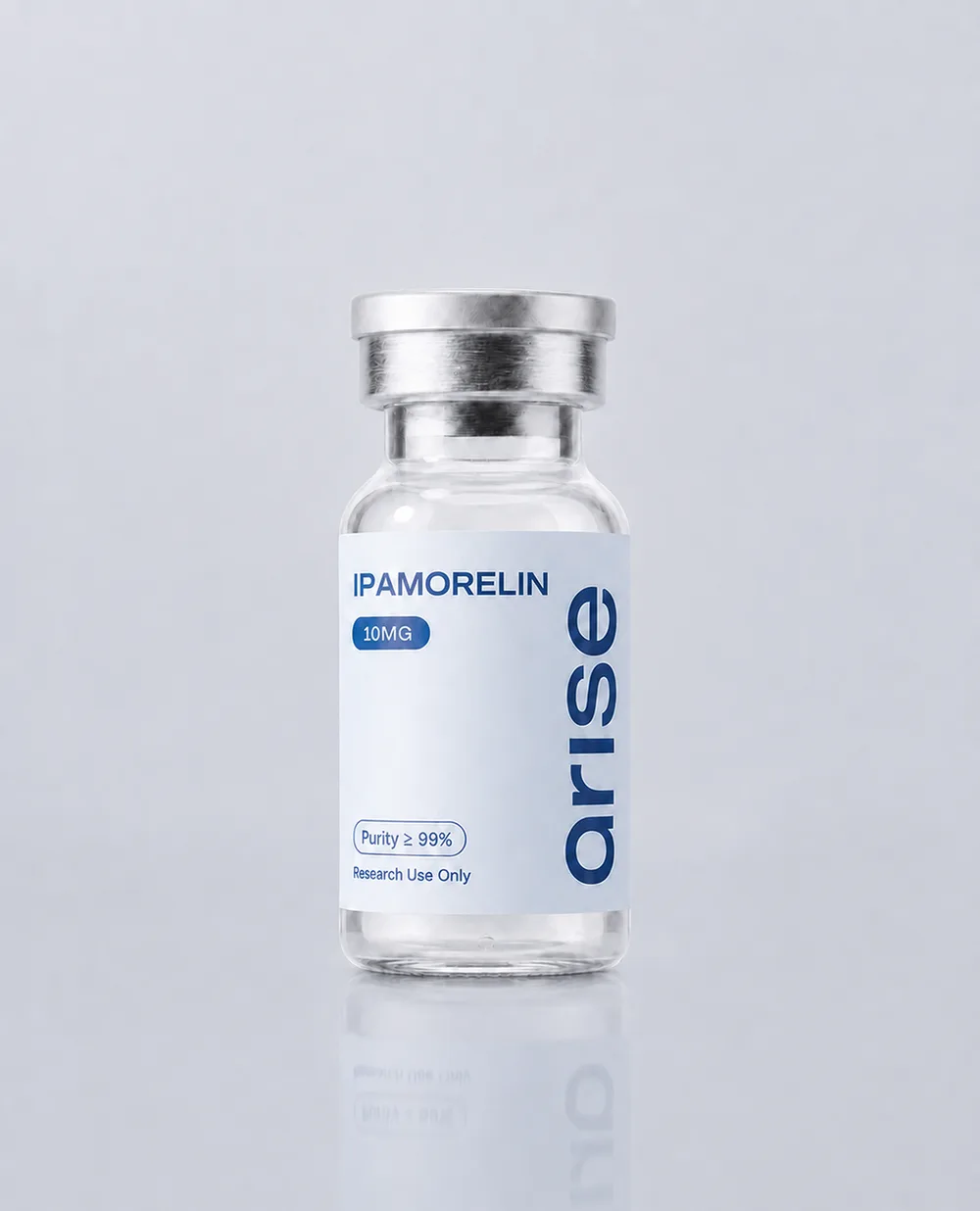
Ipamorelin
Selective pentapeptide growth-hormone secretagogue.
Important research notice
Not for human consumption. This product is sold exclusively for research and educational purposes. It is not intended to diagnose, treat, cure, or prevent any disease.
This material is supplied exclusively as a research reagent for in vitro and laboratory use by qualified researchers. It is not a drug, dietary supplement, cosmetic, or medical device, is not intended for human or veterinary use, and is not intended to diagnose, treat, cure, or prevent any disease. No dosing, administration, therapeutic, or benefit claims are made or implied. Cited literature is provided for scientific reference only and does not constitute a representation of efficacy or safety in any subject.
By purchasing this product, you confirm that you are a qualified researcher and will use it in accordance with all applicable laws and regulations.