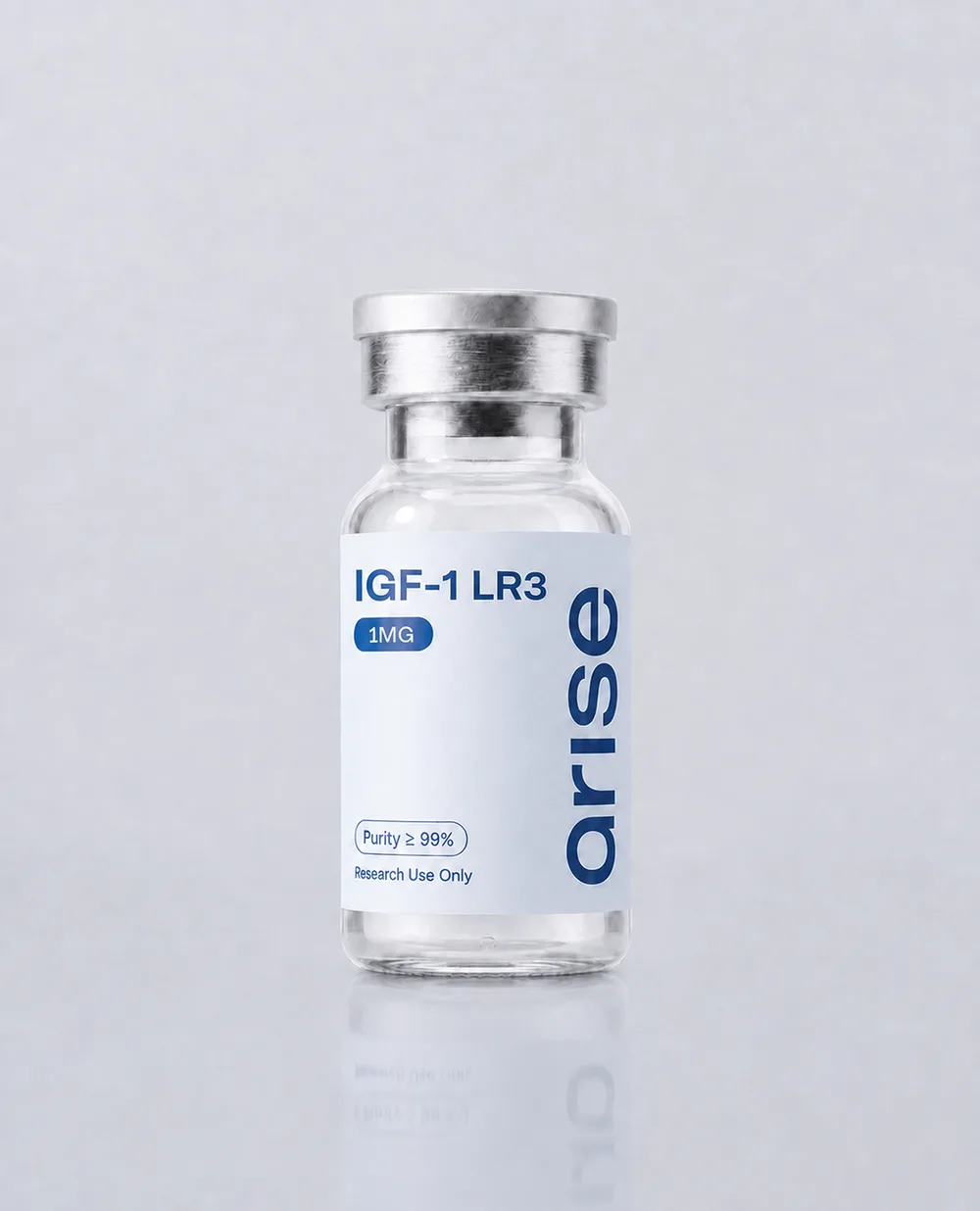
IGF-1 LR3
1MG83-residue recombinant IGF-1 analog.
6 peer-reviewed citations for this compound
Read the sourcesVolume tiers count vials of this compound at this strength. Mixing different compounds does not combine toward a tier.
- ≥99% purity specification
- Secure checkout
- Ships in 1 business day
- Research use only
Released against a ≥99% HPLC purity specification and supplied as a sealed laboratory reagent for in vitro research use only.
- Type
- Recombinant IGF-1 analog (Long R3)
- CAS number
- 946870-92-4
- Molecular weight
- 9111 g/mol
- Amino acids
- 83
- Form
- Lyophilized powder
- Vial strength
- 1MG
- Purity specification
- ≥99% by HPLC
Identifiers are published properties of the molecule. Values we cannot confirm are omitted rather than estimated.
Dispatch
Ships within 1 business day of order confirmation, from the US. Vials ship lyophilized at ambient temperature; move them to the storage condition below on arrival.
Lyophilized
Store at -20°C, protected from light. Stable 24+ months sealed.
Reconstituted
Store at 2-8°C. Use within approximately 30 days.
How IGF-1 LR3 is described to act.
Long R3 IGF-I is a recombinant analogue of insulin-like growth factor-I carrying an arginine substitution at residue 3 together with an N-terminal extension peptide, modifications that markedly reduce affinity for the IGF binding proteins while retaining signaling through the type 1 IGF receptor. The reduced binding-protein affinity is the mechanism the literature offers for its greater in vivo potency relative to native IGF-I in several rodent models. Receptor-level work reported that IGFBP-3 inhibits IGF receptor phosphorylation induced by IGF-I, IGF-II, Des(1-3)IGF-I and Long(R3)IGF-I largely by sequestering ligand in the extracellular milieu rather than by interacting with the receptor directly. In intact animals, chronic exposure has been reported to lower circulating growth hormone, IGF-I and IGF binding protein-3, consistent with feedback on the somatotropic axis.
Mechanistic descriptions summarize published in vitro and animal work. They are not a representation of efficacy or safety in any subject, and no administration guidance is given or implied.
In streptozotocin-induced diabetic rats, LR3-IGF-I and des(1-3)IGF-I were reported to be roughly 2.5 to 3 times more potent than native IGF-I at restoring growth rate and nitrogen balance, with the added weight gain composed of protein rather than the fat observed in insulin-treated reference animals. In guinea pigs, seven-day infusion increased the fractional weight of adrenals, gut, kidneys and spleen while lowering plasma IGF-I, IGF-II and IGF binding protein concentrations, without stimulating overall body growth. In finisher pigs the same analogue decreased average daily gain, food intake and plasma IGFBP-3, IGF-I and insulin, and reduced mean and pulsatile growth hormone concentrations, illustrating pronounced species-dependent responses. Protein-engineering work mapped the preferred pepsin cleavage sites within long-R3-IGF-I and generated single-point muteins, one of which showed markedly improved proteolytic stability while retaining growth-promoting activity. A forensic mass spectrometry report identified His-tagged research-grade Long-R3-IGF-I, a form normally produced for biochemical studies, in a confiscated black-market injection vial with the affinity tag still attached.
Sources & references
Cited literature is provided for scientific reference only and does not constitute a representation of efficacy or safety in any subject. All research findings presented are sourced from peer-reviewed journals and are provided for educational reference only.
- 01Detection of His-tagged Long-R³-IGF-I in a black market product
Kohler M, et al. · Growth Horm IGF Res, 2010
- 02Effect of IGFBP-3 on IGF- and IGF-analogue-induced insulin-like growth factor-I receptor (IGFIR) signalling
Devi GR, et al. · Growth Horm IGF Res, 2001
- 03
- 04Design and characterisation of long-R3-insulin-like growth factor-I muteins which show resistance to pepsin digestion
Bryant KJ, et al. · Growth Factors, 1996
- 05
- 06
Every entry links to its record at the publisher or on PubMed. Titles are reproduced exactly as published.
Further searches
Live database searches for IGF-1 LR3, run against the current index and retrieved independently of this site.
Bench handling, not a dosing guide.
Intended use
Supplied exclusively as a research reagent for in vitro and laboratory use by qualified researchers. Not a drug, dietary supplement, cosmetic or medical device, and not for human or veterinary use. No dosing, route or administration guidance is provided for any compound in this catalog.
Personal protection
Handle in a controlled laboratory environment with gloves and eye protection. Avoid generating or inhaling airborne particulate when opening a vial, and do not handle the material outside a designated work area.
Recombinant protein handling
An 83-residue recombinant protein. Aliquot after reconstitution and avoid repeated freeze-thaw cycles, which drive aggregation and loss of activity.
Opening and reconstitution
Lyophilized peptides are hygroscopic. Let the sealed vial equilibrate to room temperature before opening so atmospheric moisture does not condense onto the powder. Reconstitute by directing diluent down the vial wall and swirling until dissolved — do not shake, which shears and foams the peptide.
Stability and aliquoting
Store at -20°C, protected from light. Stable 24+ months sealed. Store at 2-8°C. Use within approximately 30 days. Aliquot reconstituted material and minimize repeated freeze-thaw cycles.
Waste disposal
Dispose of unused material, reconstituted solutions and sharps through your institution's chemical and biological waste stream, in accordance with local regulations. Do not dispose of research material in domestic waste or to drain.
Others in secretagogue research
CJC-1295 (no DAC)
Modified GRF (1-29) secretagogue analog.
CJC (no DAC) / Ipamorelin
Mod GRF (1-29) and ipamorelin blend.
Ipamorelin
Selective pentapeptide growth-hormone secretagogue.
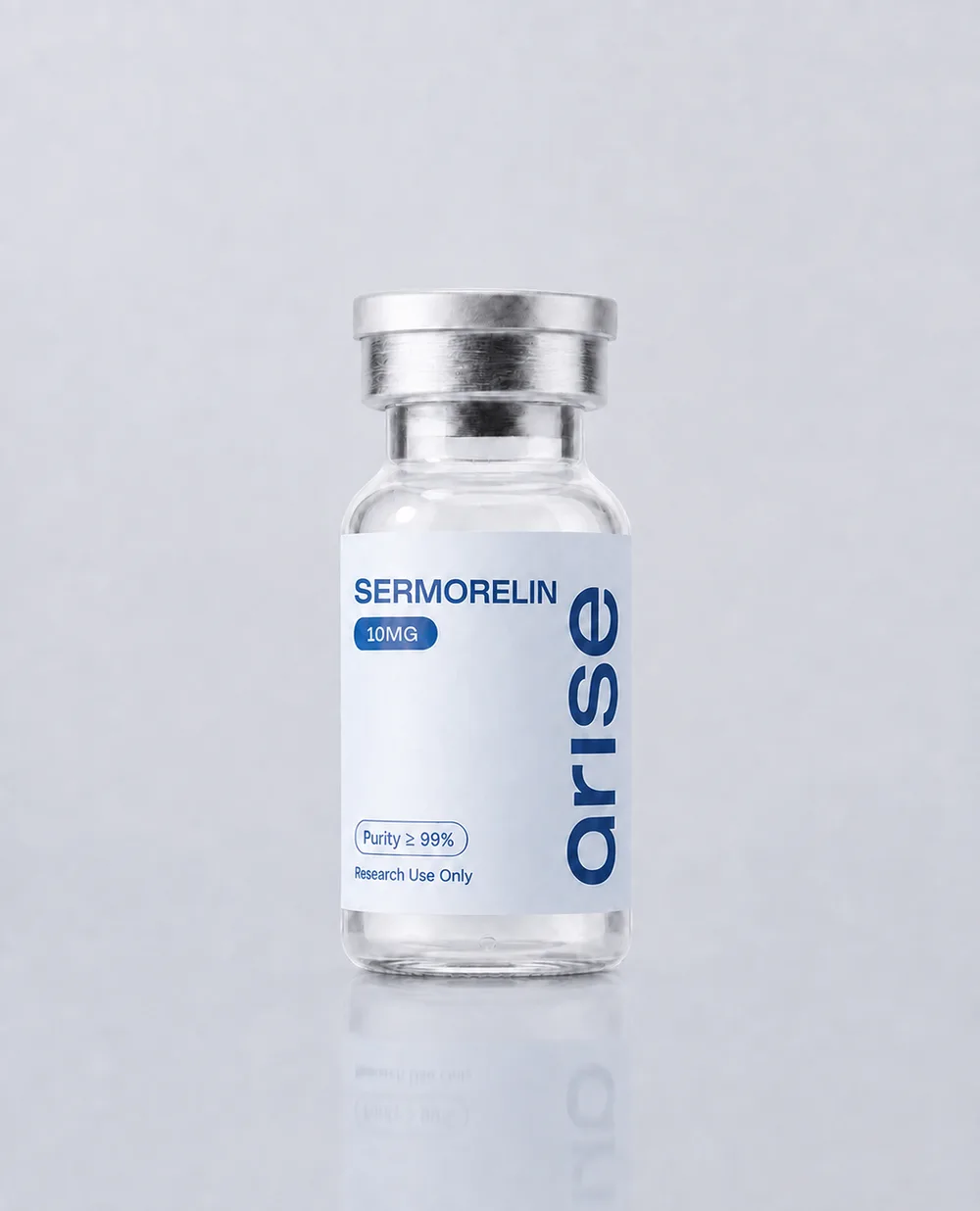
Sermorelin
GHRH (1-29) amide, 29 residues.
Important research notice
Not for human consumption. This product is sold exclusively for research and educational purposes. It is not intended to diagnose, treat, cure, or prevent any disease.
This material is supplied exclusively as a research reagent for in vitro and laboratory use by qualified researchers. It is not a drug, dietary supplement, cosmetic, or medical device, is not intended for human or veterinary use, and is not intended to diagnose, treat, cure, or prevent any disease. No dosing, administration, therapeutic, or benefit claims are made or implied. Cited literature is provided for scientific reference only and does not constitute a representation of efficacy or safety in any subject.
By purchasing this product, you confirm that you are a qualified researcher and will use it in accordance with all applicable laws and regulations.