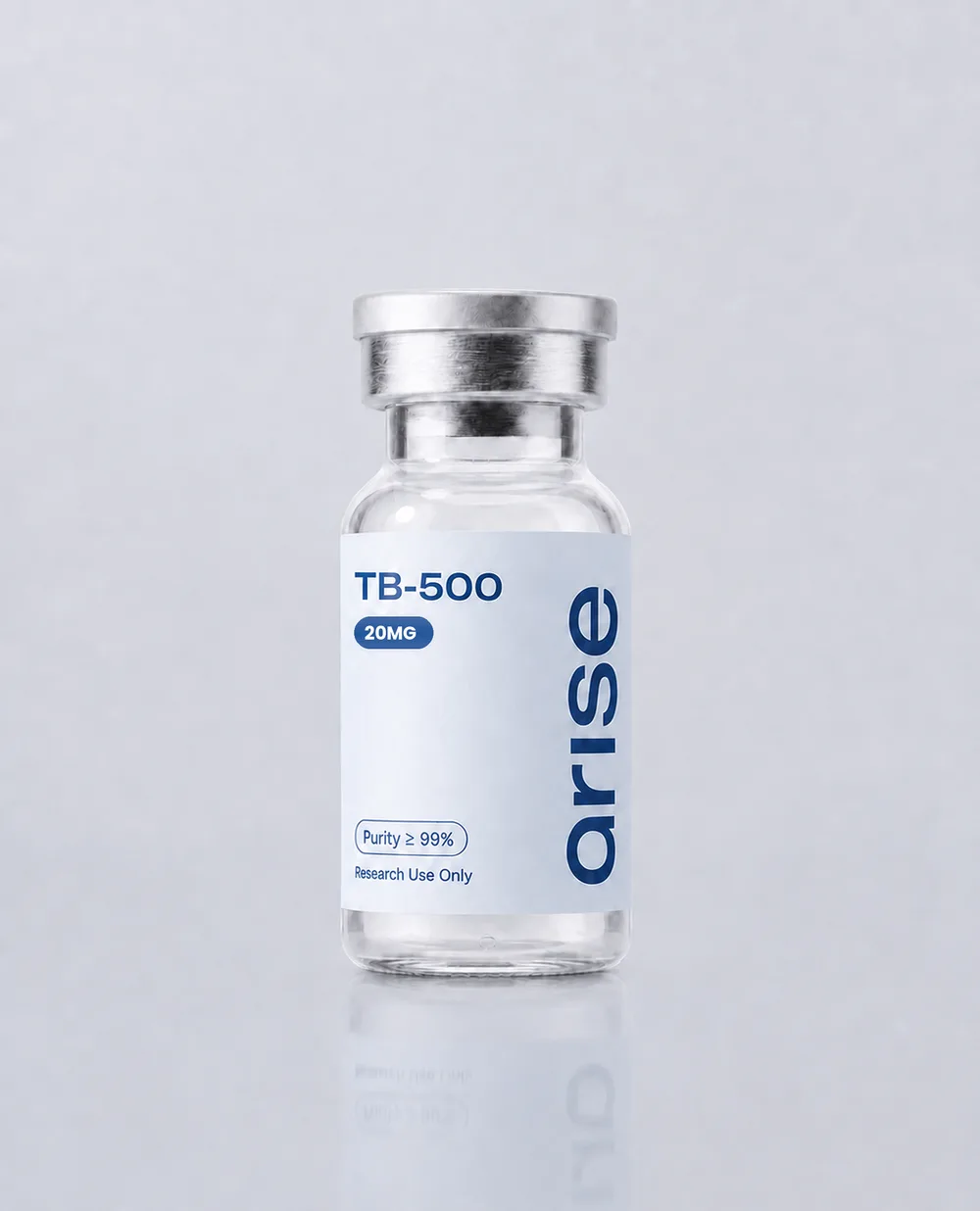
TB-500
20MGThymosin beta-4 active fragment.
12 peer-reviewed citations for this compound
Read the sourcesVolume tiers count vials of this compound at this strength. Mixing different compounds does not combine toward a tier.
- ≥99% purity specification
- Secure checkout
- Ships in 1 business day
- Research use only
Released against a ≥99% HPLC purity specification and supplied as a sealed laboratory reagent for in vitro research use only.
- Type
- Thymosin beta-4 active fragment
- Molecular weight
- 889.0 g/mol
- Amino acids
- 7
- Sequence
- Ac-Leu-Lys-Lys-Thr-Glu-Thr-Gln
- Form
- Lyophilized powder
- Vial strength
- 20MG
- Purity specification
- ≥99% by HPLC
Identifiers are published properties of the molecule. Values we cannot confirm are omitted rather than estimated.
Dispatch
Ships within 1 business day of order confirmation, from the US. Vials ship lyophilized at ambient temperature; move them to the storage condition below on arrival.
Lyophilized
Store at -20°C, protected from light. Stable 24+ months sealed.
Reconstituted
Store at 2-8°C. Use within approximately 30 days.
How TB-500 is described to act.
TB-500 is a formulation whose characterized active ingredient is a synthetic, N-terminally acetylated version of the thymosin beta-4 17-23 fragment (Ac-LKKTETQ), the region of the parent peptide responsible for actin binding. Thymosin beta-4 is the major G-actin-sequestering molecule in mammalian cells; biophysical work reports that binding alters the conformation and structural dynamics of actin monomers, slows amide proton exchange, and inhibits nucleotide exchange, with the peptide C-terminus contacting actin near His40. Reviews describe, in animal and in vitro systems, downregulation of inflammatory chemokines and cytokines, promotion of cell migration, blood vessel formation, cell survival, and mobilization and differentiation of stem/progenitor cells. Reduced myofibroblast numbers in wound tissue are also reported in preclinical models.
Mechanistic descriptions summarize published in vitro and animal work. They are not a representation of efficacy or safety in any subject, and no administration guidance is given or implied.
Analytical chemistry established the composition of TB-500 itself: high-resolution mass spectrometry confirmed Ac-LKKTETQ as the key ingredient, and LC-MS methods were developed to detect the parent peptide and its metabolites in equine urine and plasma at sub-ng/mL levels for doping control. Most biological data concern the full thymosin beta-4 protein rather than the marketed fragment. Animal studies spanning dermal, corneal, and cardiac injury models are described in reviews as the scientific foundation for subsequent multicenter clinical programs, with reported activity in diabetic, aged, and burn models. Review literature states that phase 2 trials in patients with pressure ulcers, stasis ulcers, and epidermolysis bullosa wounds examined rate of wound repair as the endpoint. Mechanistic biophysics remains the best-established layer of evidence, characterizing monomer sequestration in purified systems rather than in whole organisms. A randomised, placebo-controlled, double-masked phase 3 trial of a 0.1% thymosin beta-4 ophthalmic solution in stage 2 and 3 neurotrophic keratopathy examined complete healing of persistent epithelial defects at four weeks; complete healing occurred in 6 of 10 treated and 1 of 8 placebo participants, which the authors reported at p=0.0656. A 2025 Cochrane review of medical and surgical interventions for neurotrophic keratopathy assessed this and competing treatments and noted the absence of consensus on a standard of care. Cardiac work paired a murine ischaemia-reperfusion model with subjects presenting with ST-segment elevation myocardial infarction after percutaneous coronary intervention. A review of the renal literature maps the thymosin beta-4 and Ac-SDKP axis across models of kidney injury and repair. Counterbalancing the repair literature, oncology work reports that thymosin beta-4 is upregulated in breast cancer tissue and cell lines, that high expression correlates with poor clinical outcome, and that it acts through SLC7A11 to raise glutathione biosynthesis and suppress lipid peroxidation. A sports medicine review classifies TB-500 among unapproved peptides marketed direct to patients outside regulatory oversight.
Sources & references
Cited literature is provided for scientific reference only and does not constitute a representation of efficacy or safety in any subject. All research findings presented are sourced from peer-reviewed journals and are provided for educational reference only.
- 01
- 02
- 03
- 04Medical and surgical interventions for neurotrophic keratopathy
Kruoch Z, et al. · Cochrane Database Syst Rev, 2025
- 05
- 06
- 07Thymosin β4 Promotes Dermal Healing
Kleinman HK, et al. · Vitam Horm, 2016
- 08
- 09
- 10Thymosin β4: a multi-functional regenerative peptide. Basic properties and clinical applications
Goldstein AL, et al. · Expert Opin Biol Ther, 2012
- 11Animal studies with thymosin beta, a multifunctional tissue repair and regeneration peptide
Philp D, et al. · Ann N Y Acad Sci, 2010
- 12Thymosin-beta(4) changes the conformation and dynamics of actin monomers
De La Cruz EM, et al. · Biophys J, 2000
Every entry links to its record at the publisher or on PubMed. Titles are reproduced exactly as published.
Further searches
Live database searches for TB-500, run against the current index and retrieved independently of this site.
Bench handling, not a dosing guide.
Intended use
Supplied exclusively as a research reagent for in vitro and laboratory use by qualified researchers. Not a drug, dietary supplement, cosmetic or medical device, and not for human or veterinary use. No dosing, route or administration guidance is provided for any compound in this catalog.
Personal protection
Handle in a controlled laboratory environment with gloves and eye protection. Avoid generating or inhaling airborne particulate when opening a vial, and do not handle the material outside a designated work area.
Opening and reconstitution
Lyophilized peptides are hygroscopic. Let the sealed vial equilibrate to room temperature before opening so atmospheric moisture does not condense onto the powder. Reconstitute by directing diluent down the vial wall and swirling until dissolved — do not shake, which shears and foams the peptide.
Stability and aliquoting
Store at -20°C, protected from light. Stable 24+ months sealed. Store at 2-8°C. Use within approximately 30 days. Aliquot reconstituted material and minimize repeated freeze-thaw cycles.
Waste disposal
Dispose of unused material, reconstituted solutions and sharps through your institution's chemical and biological waste stream, in accordance with local regulations. Do not dispose of research material in domestic waste or to drain.
Others in healing & recovery
ARA-290
11-residue erythropoietin-derived peptide.
BPC-157
Synthetic 15-residue gastric pentadecapeptide.
Wolverine(BPC-157 / TB-500)
Co-formulated BPC-157 and TB-500 blend.
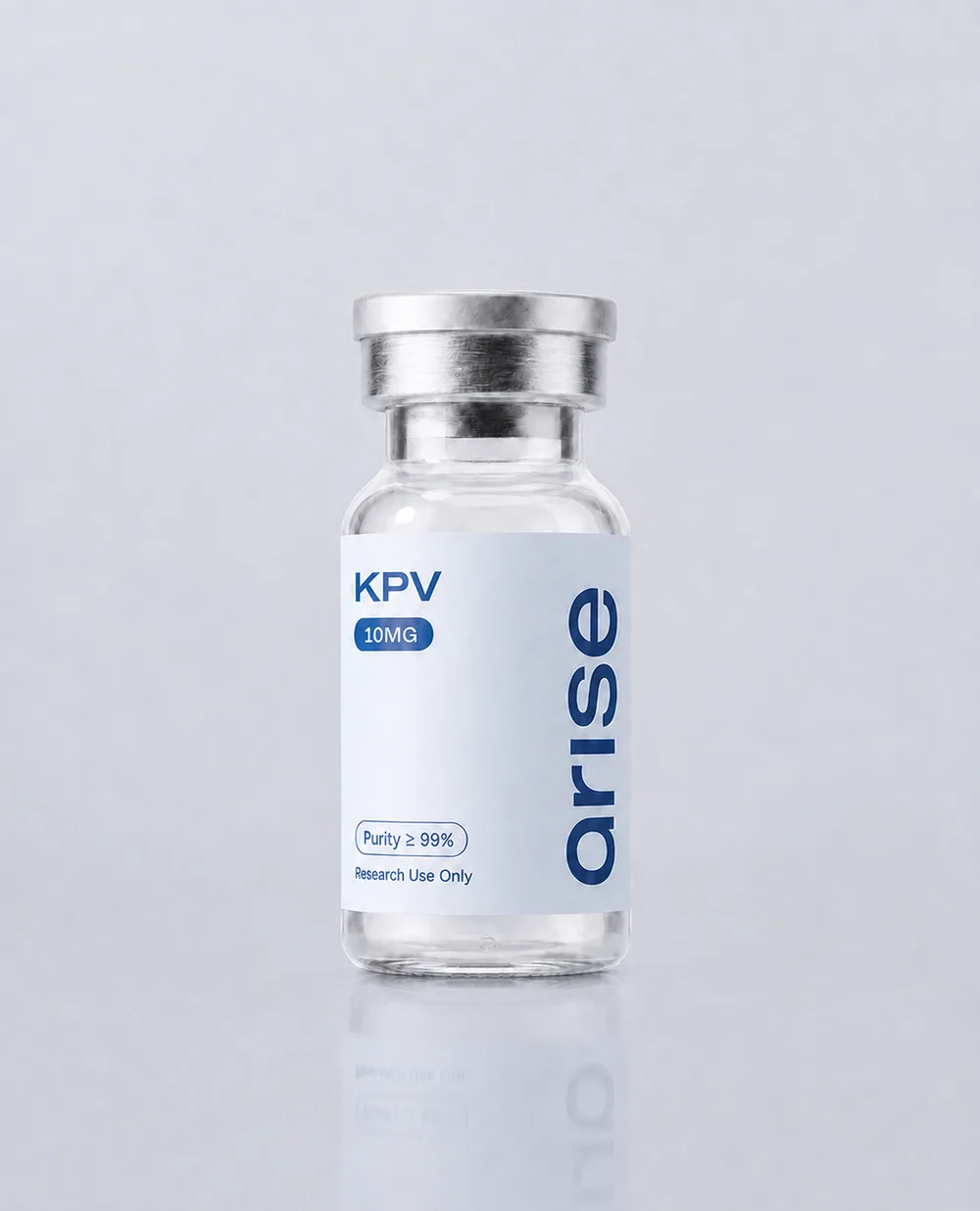
KPV
C-terminal alpha-MSH tripeptide.
Important research notice
Not for human consumption. This product is sold exclusively for research and educational purposes. It is not intended to diagnose, treat, cure, or prevent any disease.
This material is supplied exclusively as a research reagent for in vitro and laboratory use by qualified researchers. It is not a drug, dietary supplement, cosmetic, or medical device, is not intended for human or veterinary use, and is not intended to diagnose, treat, cure, or prevent any disease. No dosing, administration, therapeutic, or benefit claims are made or implied. Cited literature is provided for scientific reference only and does not constitute a representation of efficacy or safety in any subject.
By purchasing this product, you confirm that you are a qualified researcher and will use it in accordance with all applicable laws and regulations.