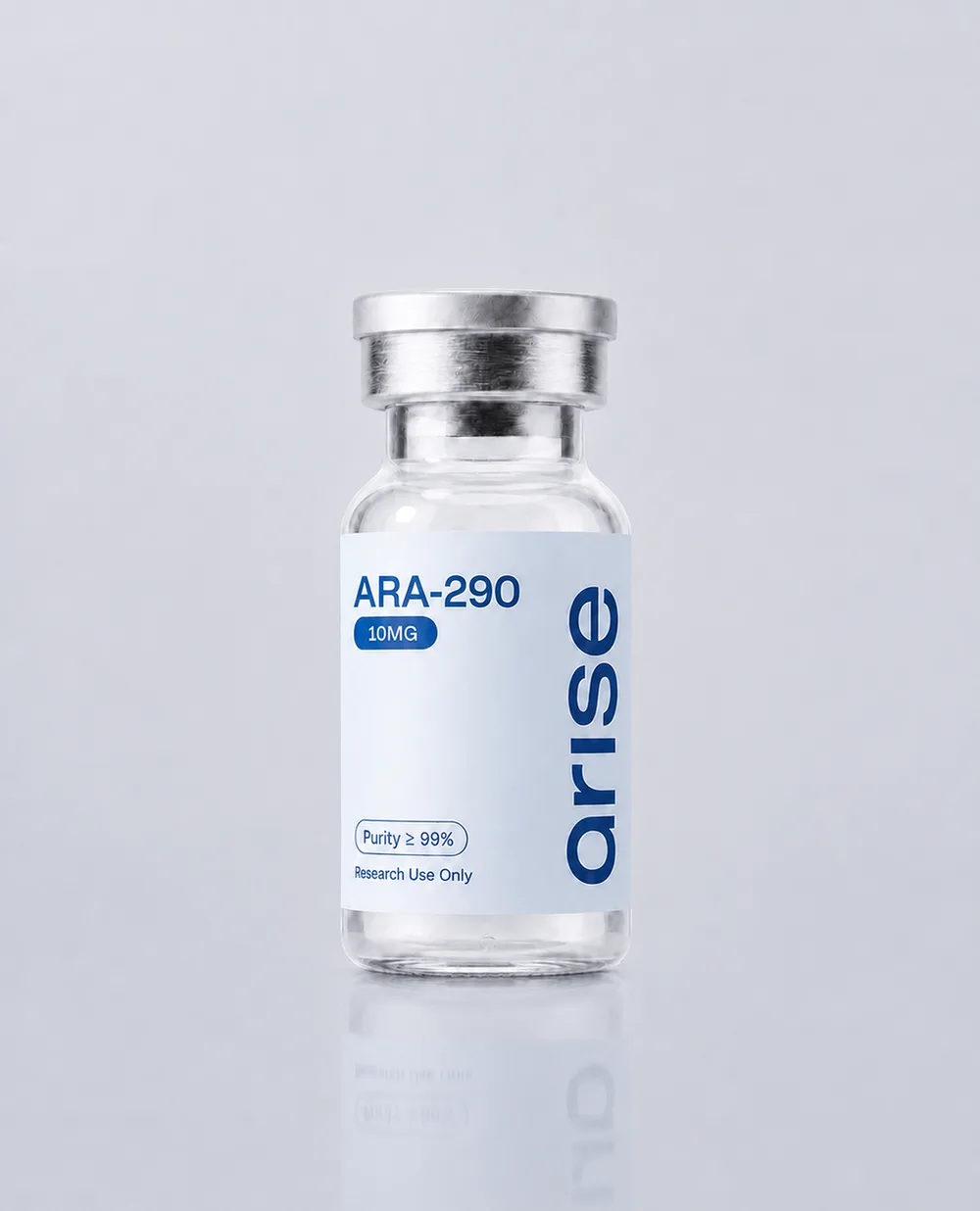
ARA-290
10MG11-residue erythropoietin-derived peptide.
6 peer-reviewed citations for this compound
Read the sourcesVolume tiers count vials of this compound at this strength. Mixing different compounds does not combine toward a tier.
- ≥99% purity specification
- Secure checkout
- Ships in 1 business day
- Research use only
Released against a ≥99% HPLC purity specification and supplied as a sealed laboratory reagent for in vitro research use only.
- Type
- Erythropoietin-derived peptide (cibinetide)
- CAS number
- 1208243-50-8
- Amino acids
- 11
- Form
- Lyophilized powder
- Vial strength
- 10MG
- Purity specification
- ≥99% by HPLC
Identifiers are published properties of the molecule. Values we cannot confirm are omitted rather than estimated.
Dispatch
Ships within 1 business day of order confirmation, from the US. Vials ship lyophilized at ambient temperature; move them to the storage condition below on arrival.
Lyophilized
Store at -20°C, protected from light. Stable 24+ months sealed.
Reconstituted
Store at 2-8°C. Use within approximately 30 days.
How ARA-290 is described to act.
ARA-290 (cibinetide) is an 11-amino-acid peptide built from the adjacent residues forming the aqueous face of helix B of erythropoietin, the surface that is solvent-exposed when erythropoietin is bound to its receptor homodimer. It is described as acting not at the erythropoietin receptor homodimer that drives erythropoiesis but at a heterocomplex of the erythropoietin receptor and the beta-common receptor CD131, termed the innate repair receptor, and the peptide is non-erythropoietic in vitro and in vivo. In LPS-activated mouse primary macrophages the anti-inflammatory effect of cibinetide depended on CD131 and JAK2 functionality and was mediated via inhibition of NF-kappaB subunit p65. In mice with genetic diabetes, cibinetide raised wound VEGF, phospho-Akt, phospho-eNOS and nitrite/nitrate content while lowering malondialdehyde.
Mechanistic descriptions summarize published in vitro and animal work. They are not a representation of efficacy or safety in any subject, and no administration guidance is given or implied.
Helix-B-derived peptides were neuroprotective in vitro and tissue protective in rodent models of ischemic stroke, diabetes-induced retinal edema, peripheral nerve trauma and renal ischemia-reperfusion, without stimulating erythropoiesis in vitro or in vivo. In DSS-induced colitis in C57BL/6N mice, cibinetide reduced myeloid infiltration and production of cytokines, chemokines and nitric oxide synthase-2, with improved weight gain and survival. A 22-patient double-blind, placebo-controlled exploratory trial in sarcoidosis patients with small fiber neuropathy symptoms raised no safety concerns by clinical or laboratory assessment and reported a change in the small fiber neuropathy screening list score relative to placebo, but Brief Pain Inventory and Fatigue Assessment Scale scores changed significantly and equivalently in both arms, showing no separation from placebo on those endpoints. A 64-subject phase 2b randomized trial using change in corneal nerve fiber area at 28 days as its primary endpoint found a placebo-corrected increase reaching significance only at the 4 mg dose (P=0.012), with the 1 mg and 8 mg confidence intervals spanning zero and the placebo-corrected pain intensity comparison not reaching significance (P=0.157). A 28-day phase 2 study in type 2 diabetes measured haemoglobin A1c, lipid profiles, PainDetect scores and corneal nerve fiber density, and its authors framed the observations as warranting continued clinical evaluation rather than as establishing efficacy.
Sources & references
Cited literature is provided for scientific reference only and does not constitute a representation of efficacy or safety in any subject. All research findings presented are sourced from peer-reviewed journals and are provided for educational reference only.
- 01Activation of the EPOR-β common receptor complex by cibinetide ameliorates impaired wound healing in mice with genetic diabetes
Bitto A, et al. · Biochim Biophys Acta Mol Basis Dis, 2018
- 02Cibinetide Improves Corneal Nerve Fiber Abundance in Patients With Sarcoidosis-Associated Small Nerve Fiber Loss and Neuropathic Pain
Culver DA, et al. · Invest Ophthalmol Vis Sci, 2017
- 03
- 04
- 05
- 06Nonerythropoietic, tissue-protective peptides derived from the tertiary structure of erythropoietin
Brines M, et al. · Proc Natl Acad Sci U S A, 2008
Every entry links to its record at the publisher or on PubMed. Titles are reproduced exactly as published.
Further searches
Live database searches for ARA-290, run against the current index and retrieved independently of this site.
Bench handling, not a dosing guide.
Intended use
Supplied exclusively as a research reagent for in vitro and laboratory use by qualified researchers. Not a drug, dietary supplement, cosmetic or medical device, and not for human or veterinary use. No dosing, route or administration guidance is provided for any compound in this catalog.
Personal protection
Handle in a controlled laboratory environment with gloves and eye protection. Avoid generating or inhaling airborne particulate when opening a vial, and do not handle the material outside a designated work area.
Opening and reconstitution
Lyophilized peptides are hygroscopic. Let the sealed vial equilibrate to room temperature before opening so atmospheric moisture does not condense onto the powder. Reconstitute by directing diluent down the vial wall and swirling until dissolved — do not shake, which shears and foams the peptide.
Stability and aliquoting
Store at -20°C, protected from light. Stable 24+ months sealed. Store at 2-8°C. Use within approximately 30 days. Aliquot reconstituted material and minimize repeated freeze-thaw cycles.
Waste disposal
Dispose of unused material, reconstituted solutions and sharps through your institution's chemical and biological waste stream, in accordance with local regulations. Do not dispose of research material in domestic waste or to drain.
Others in healing & recovery
BPC-157
Synthetic 15-residue gastric pentadecapeptide.
Wolverine(BPC-157 / TB-500)
Co-formulated BPC-157 and TB-500 blend.
KPV
C-terminal alpha-MSH tripeptide.
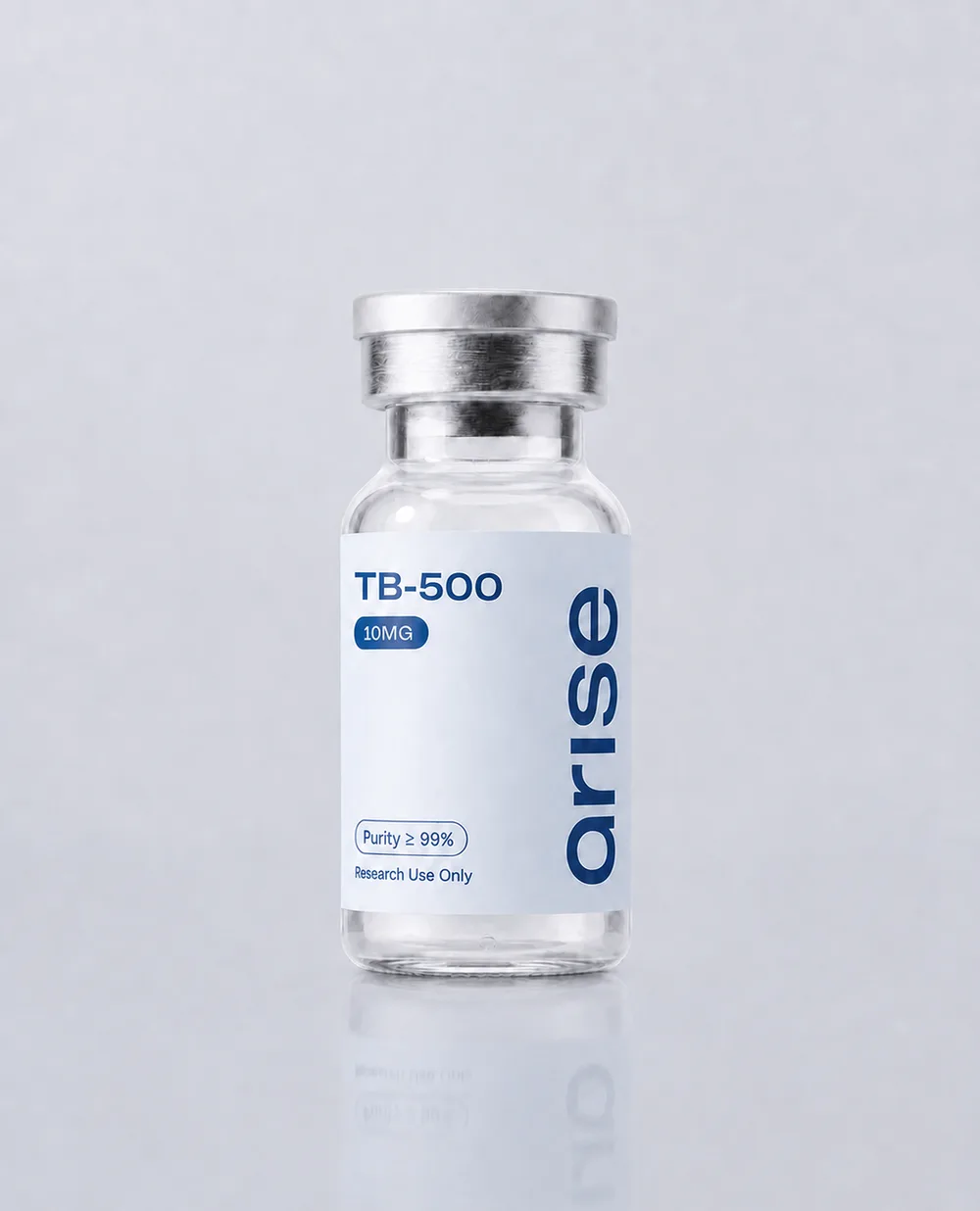
TB-500
Thymosin beta-4 active fragment.
Important research notice
Not for human consumption. This product is sold exclusively for research and educational purposes. It is not intended to diagnose, treat, cure, or prevent any disease.
This material is supplied exclusively as a research reagent for in vitro and laboratory use by qualified researchers. It is not a drug, dietary supplement, cosmetic, or medical device, is not intended for human or veterinary use, and is not intended to diagnose, treat, cure, or prevent any disease. No dosing, administration, therapeutic, or benefit claims are made or implied. Cited literature is provided for scientific reference only and does not constitute a representation of efficacy or safety in any subject.
By purchasing this product, you confirm that you are a qualified researcher and will use it in accordance with all applicable laws and regulations.