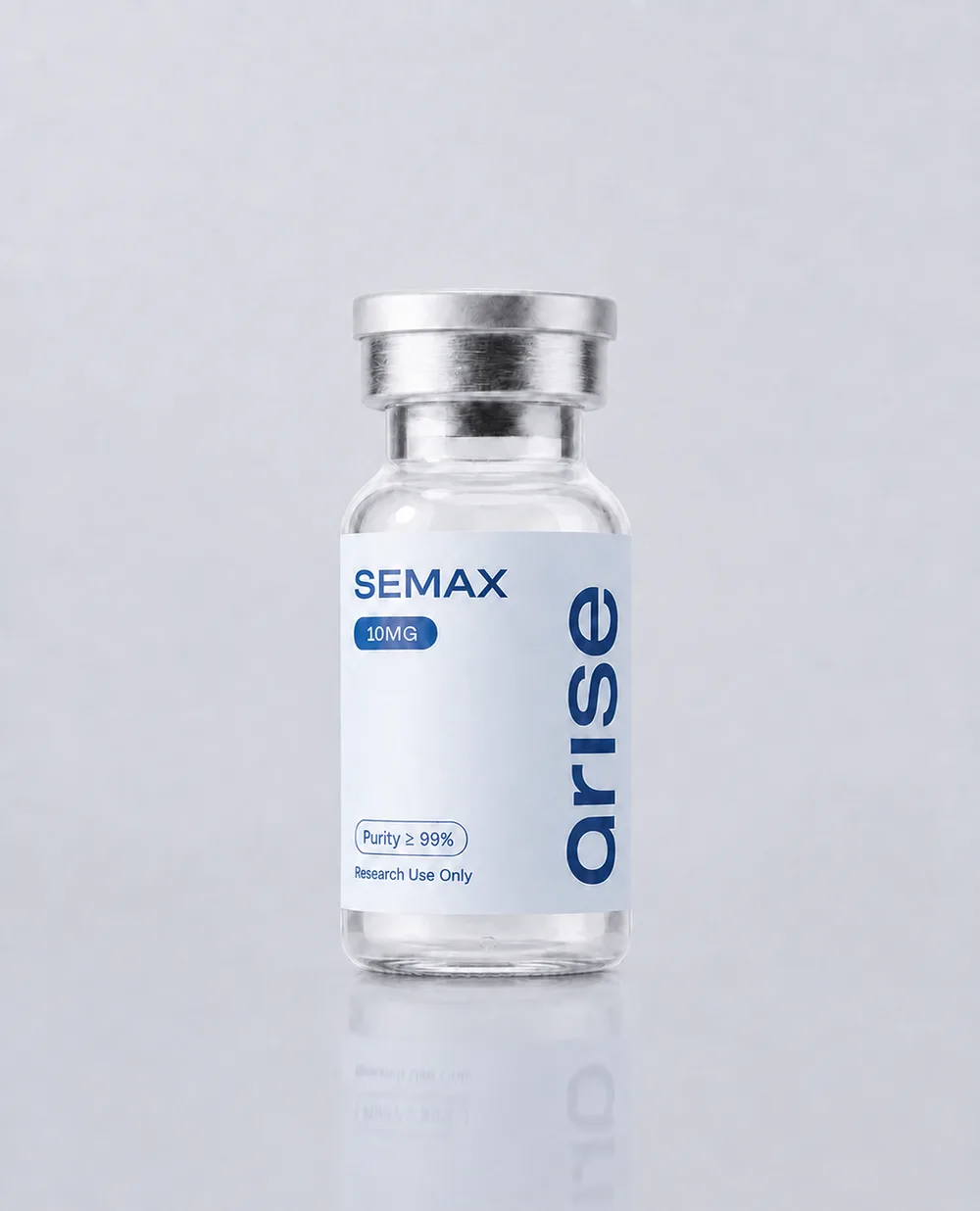
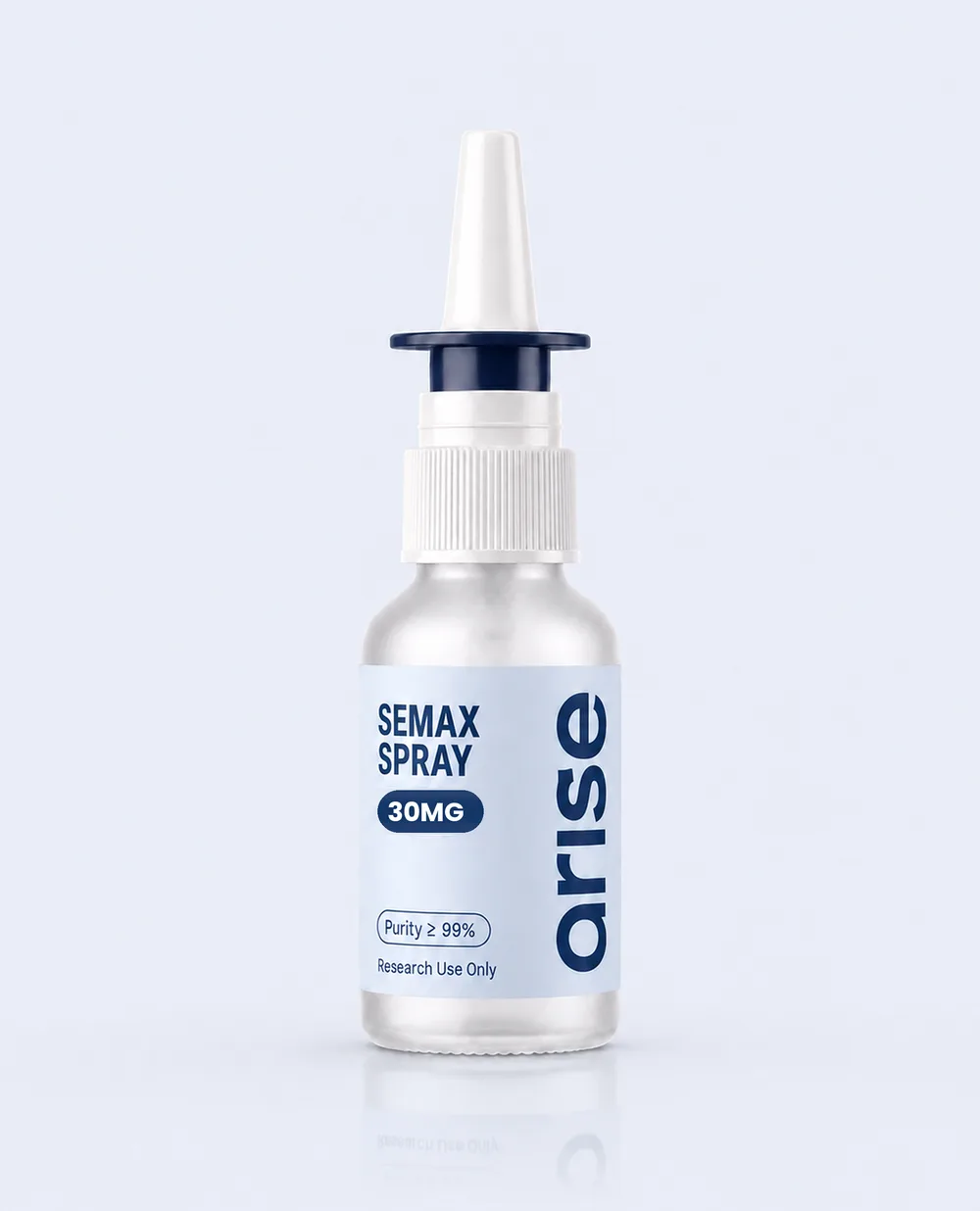
Semax
10MGACTH (4-10) analog heptapeptide.
12 peer-reviewed citations for this compound
Read the sourcesVolume tiers count vials of this compound at this strength. Mixing different compounds does not combine toward a tier.
- ≥99% purity specification
- Secure checkout
- Ships in 1 business day
- Research use only
Released against a ≥99% HPLC purity specification and supplied as a sealed laboratory reagent for in vitro research use only.
- Type
- ACTH (4-10) analog heptapeptide
- CAS number
- 80714-61-0
- Molecular formula
- C37H51N9O10S
- Molecular weight
- 813.92 g/mol
- Amino acids
- 7
- Sequence
- Met-Glu-His-Phe-Pro-Gly-Pro
- Form
- Lyophilized powder
- Vial strength
- 10MG
- Purity specification
- ≥99% by HPLC
Identifiers are published properties of the molecule. Values we cannot confirm are omitted rather than estimated.
Dispatch
Ships within 1 business day of order confirmation, from the US. Vials ship lyophilized at ambient temperature; move them to the storage condition below on arrival.
Lyophilized
Store at -20°C, protected from light. Stable 24+ months sealed.
Reconstituted
Store at 2-8°C. Use within approximately 30 days.
How Semax is described to act.
Semax is a synthetic heptapeptide (Met-Glu-His-Phe-Pro-Gly-Pro) consisting of the ACTH(4-7) fragment extended by a C-terminal Pro-Gly-Pro tripeptide that slows enzymatic cleavage. Radioligand work on plasma membranes from rat forebrain basal nuclei described binding that was time-dependent, specific, reversible and calcium-dependent, with a nanomolar dissociation constant, and identified dipeptidylaminopeptidases as the principal degrading enzymes, cleaving the peptide successively to HFPGP and PGP. Reported downstream signalling in rodent brain centres on the BDNF/trkB system, with increases in hippocampal BDNF protein, trkB tyrosine phosphorylation and the corresponding mRNAs, alongside region-specific changes in Ngf and Bdnf transcription. In rodents the peptide also modulates monoaminergic tone, raising striatal extracellular 5-HIAA and potentiating amphetamine-evoked dopamine release, and it has been reported to attenuate nitric oxide overproduction in ischaemic cortex.
Mechanistic descriptions summarize published in vitro and animal work. They are not a representation of efficacy or safety in any subject, and no administration guidance is given or implied.
In rats, a single application increased hippocampal BDNF protein about 1.4-fold and trkB tyrosine phosphorylation about 1.6-fold, with larger increases in exon III BDNF and trkB mRNA, and treated animals showed more conditioned avoidance reactions. Real-time PCR after intranasal application showed increased Ngf and Bdnf expression in hippocampus, increased Bdnf in brainstem and cerebellum, and decreased Ngf in frontal cortex, indicating gene- and region-specific transcriptional effects. In a rat model of incomplete global ischaemia the peptide reduced the ischaemia-associated rise in cortical nitric oxide, whereas glycine did not. In a chronic unpredictable stress model in male Sprague-Dawley rats, chronic administration attenuated stress-induced anhedonia in the sucrose preference test, suppressed adrenal hypertrophy and body-weight changes and reversed the decrease in hippocampal BDNF, while no effect on forced-swim immobility was detected. Neurochemical studies in rodents reported a gradual rise in extracellular striatal 5-HIAA and marked enhancement of amphetamine-induced dopamine release and locomotor activity; all six cited records are preclinical, and none is a controlled human trial. In a spinal cord injury model in female mice, the peptide was examined against lysosomal membrane permeabilisation and ubiquitination, with the mu opioid receptor gene Oprm1 identified as a target and functional recovery as the endpoint. In an animal model of Alzheimer's disease the peptide and a derivative were assessed against pathological impairments, and in artificial membrane systems the peptide altered copper-induced amyloid beta aggregation and amyloid formation in vitro. High-throughput RNA sequencing of rat frontal cortex under normal physiological conditions identified differentially expressed genes, which the authors framed explicitly as characterising the risks of administration rather than only its effects. A further rat study examined behavioural and neurochemical alterations following early-life fluvoxamine exposure. Analytical work on two suspicious preparations seized in 2017 and 2018 identified Selank and Semax as their contents; the analysing laboratory noted that these research peptides have not completed any clinical trials and are freely available as lyophilised powder for injection and in nasal sprays.
Sources & references
Cited literature is provided for scientific reference only and does not constitute a representation of efficacy or safety in any subject. All research findings presented are sourced from peer-reviewed journals and are provided for educational reference only.
- 01
- 02
- 03
- 04Changes of Transcriptomic Activity in Rat Brain Cells under the Influence of Synthetic Adrenocorticotropic Hormone-Like Peptides
Filippenkov IB, et al. · Biochemistry (Mosc), 2024
- 05Semax, a Synthetic Regulatory Peptide, Affects Copper-Induced Abeta Aggregation and Amyloid Formation in Artificial Membrane Models
Sciacca MFM, et al. · ACS Chem Neurosci, 2022
- 06
- 07
- 08Neurotrophin gene expression in rat brain under the action of Semax, an analogue of ACTH 4-10
Agapova TY, et al. · Neurosci Lett, 2007
- 09
- 10
- 11
- 12
Every entry links to its record at the publisher or on PubMed. Titles are reproduced exactly as published.
Further searches
Live database searches for Semax, run against the current index and retrieved independently of this site.
Bench handling, not a dosing guide.
Intended use
Supplied exclusively as a research reagent for in vitro and laboratory use by qualified researchers. Not a drug, dietary supplement, cosmetic or medical device, and not for human or veterinary use. No dosing, route or administration guidance is provided for any compound in this catalog.
Personal protection
Handle in a controlled laboratory environment with gloves and eye protection. Avoid generating or inhaling airborne particulate when opening a vial, and do not handle the material outside a designated work area.
Opening and reconstitution
Lyophilized peptides are hygroscopic. Let the sealed vial equilibrate to room temperature before opening so atmospheric moisture does not condense onto the powder. Reconstitute by directing diluent down the vial wall and swirling until dissolved — do not shake, which shears and foams the peptide.
Stability and aliquoting
Store at -20°C, protected from light. Stable 24+ months sealed. Store at 2-8°C. Use within approximately 30 days. Aliquot reconstituted material and minimize repeated freeze-thaw cycles.
Waste disposal
Dispose of unused material, reconstituted solutions and sharps through your institution's chemical and biological waste stream, in accordance with local regulations. Do not dispose of research material in domestic waste or to drain.
Others in neuro research
Important research notice
Not for human consumption. This product is sold exclusively for research and educational purposes. It is not intended to diagnose, treat, cure, or prevent any disease.
This material is supplied exclusively as a research reagent for in vitro and laboratory use by qualified researchers. It is not a drug, dietary supplement, cosmetic, or medical device, is not intended for human or veterinary use, and is not intended to diagnose, treat, cure, or prevent any disease. No dosing, administration, therapeutic, or benefit claims are made or implied. Cited literature is provided for scientific reference only and does not constitute a representation of efficacy or safety in any subject.
By purchasing this product, you confirm that you are a qualified researcher and will use it in accordance with all applicable laws and regulations.