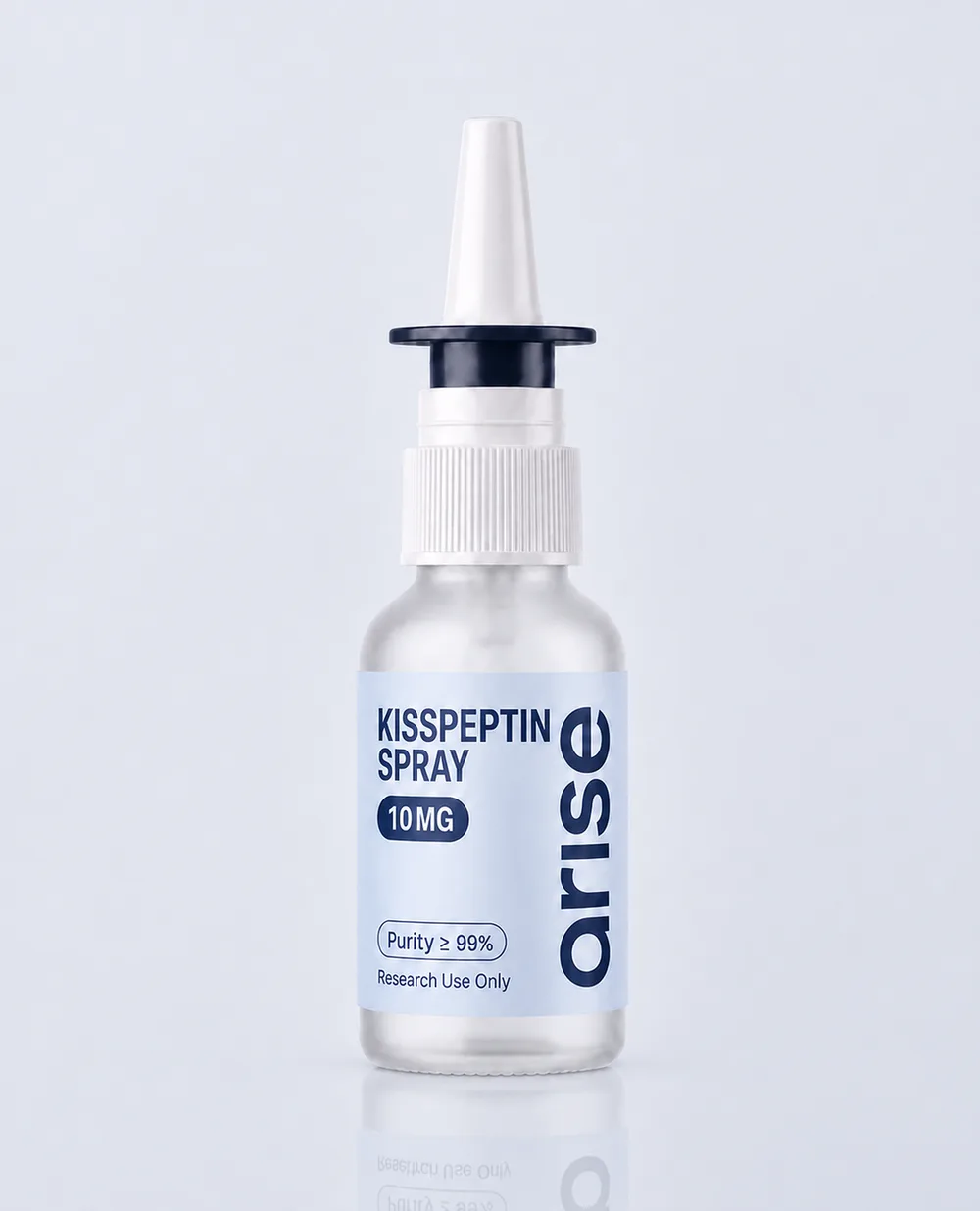
Kisspeptin Spray
10MGKisspeptin-10 in nasal research format.
6 peer-reviewed citations for this compound
Read the sourcesVolume tiers count vials of this compound at this strength. Mixing different compounds does not combine toward a tier.
- ≥99% purity specification
- Secure checkout
- Ships in 1 business day
- Research use only
Released against a ≥99% HPLC purity specification and supplied as a sealed laboratory reagent for in vitro research use only.
- Type
- Kisspeptin-10 decapeptide, nasal research format
- CAS number
- 374675-21-5
- Amino acids
- 10
- Form
- Nasal spray
- Vial strength
- 10MG
- Purity specification
- ≥99% by HPLC
Identifiers are published properties of the molecule. Values we cannot confirm are omitted rather than estimated.
Dispatch
Ships within 1 business day of order confirmation, from the US. Bottles ship in solution at ambient temperature; move them to the storage condition below on arrival.
Sealed bottle
Store at 2-8°C, protected from light.
In use
Supplied in solution. Use within approximately 30 days.
How Kisspeptin Spray is described to act.
Kisspeptins are the proteolytic products of the KISS1 gene, comprising a 54-amino-acid peptide (metastin, kisspeptin-54) and shorter kisspeptin-14, -13 and -10 fragments of similar potency, all acting at the G protein-coupled receptor GPR54 (KISS1R), which couples to Galphaq. Kisspeptin neurons located in the AVPV/RP3V and arcuate regions of the hypothalamus project to GnRH neurons, the majority of which express GPR54; receptor activation produces intense electrical activation of these neurons and GnRH secretion, driving pituitary LH and FSH release. Kiss1 expression in these populations is differentially regulated by oestrogen and progesterone, providing the substrate through which gonadal steroids exert both negative and positive feedback on GnRH output. Outside the reproductive axis, kisspeptin-10 signalling through GPR54 has been reported to negatively regulate CXCR4-mediated chemotaxis, inhibiting SDF-1-induced Akt phosphorylation and calcium mobilisation while producing prolonged ERK1/2 phosphorylation.
Mechanistic descriptions summarize published in vitro and animal work. They are not a representation of efficacy or safety in any subject, and no administration guidance is given or implied.
Loss-of-function mutations of GPR54 in humans and mice produce hypogonadotropic hypogonadism characterised by absent sexual maturation and low gonadotropin levels, while inactivating and activating mutations in KISS1 or GPR54 have been linked to hypogonadotropic hypogonadism and precocious puberty respectively. Kisspeptin administration stimulates gonadotropin release across several species and routes of administration, and central administration to immature female rats induced precocious activation of the gonadotropic axis with advanced vaginal opening, elevated uterine weight, increased serum LH and oestrogen, and ovulation. Immunoneutralisation and knockout evidence implicates RP3V kisspeptin neurons projecting to GnRH neurons as an essential component of the pre-ovulatory LH surge mechanism in rodents, with an analogous mediobasal hypothalamic population described in sheep and primates. In mice, conditional ablation of Kiss1r in GFAP-positive astrocytes altered expression of PGE2-synthesis genes, perturbed astrocyte-GnRH neuronal appositions, and changed LH responses to kisspeptin, LH pulsatility and reproductive responses to a high-fat-diet metabolic challenge, defining a non-neuronal arm of the pathway. In tumour cell models, kisspeptin-10 blocked CXCR4-dependent chemotaxis toward SDF-1/CXCL12 without downregulating surface CXCR4 or altering Galphai activation, consistent with the metastasis-suppressor activity attributed to KISS1.
Sources & references
Cited literature is provided for scientific reference only and does not constitute a representation of efficacy or safety in any subject. All research findings presented are sourced from peer-reviewed journals and are provided for educational reference only.
- 01Kisspeptin signaling in astrocytes modulates the reproductive axis
Torres E, et al. · J Clin Invest, 2024
- 02Kisspeptin/GPR54 System: What Do We Know About Its Role in Human Reproduction?
Trevisan CM, et al. · Cell Physiol Biochem, 2018
- 03Oestrogen, kisspeptin, GPR54 and the pre-ovulatory luteinising hormone surge
Clarkson J, et al. · J Neuroendocrinol, 2009
- 04GPR54 and kisspeptins
Colledge WH · Results Probl Cell Differ, 2008
- 05GPR54 and kisspeptin in reproduction
Tena-Sempere M · Hum Reprod Update, 2006
- 06
Every entry links to its record at the publisher or on PubMed. Titles are reproduced exactly as published.
Further searches
Live database searches for Kisspeptin Spray, run against the current index and retrieved independently of this site.
Bench handling, not a dosing guide.
Intended use
Supplied exclusively as a research reagent for in vitro and laboratory use by qualified researchers. Not a drug, dietary supplement, cosmetic or medical device, and not for human or veterinary use. No dosing, route or administration guidance is provided for any compound in this catalog.
Personal protection
Handle in a controlled laboratory environment with gloves and eye protection. Avoid aerosolizing the solution when opening or actuating the container, and do not handle the material outside a designated work area.
Stability and aliquoting
Store at 2-8°C, protected from light. Supplied in solution. Use within approximately 30 days.
Waste disposal
Dispose of unused material, reconstituted solutions and sharps through your institution's chemical and biological waste stream, in accordance with local regulations. Do not dispose of research material in domestic waste or to drain.
Others in neuro research
Important research notice
Not for human consumption. This product is sold exclusively for research and educational purposes. It is not intended to diagnose, treat, cure, or prevent any disease.
This material is supplied exclusively as a research reagent for in vitro and laboratory use by qualified researchers. It is not a drug, dietary supplement, cosmetic, or medical device, is not intended for human or veterinary use, and is not intended to diagnose, treat, cure, or prevent any disease. No dosing, administration, therapeutic, or benefit claims are made or implied. Cited literature is provided for scientific reference only and does not constitute a representation of efficacy or safety in any subject.
By purchasing this product, you confirm that you are a qualified researcher and will use it in accordance with all applicable laws and regulations.