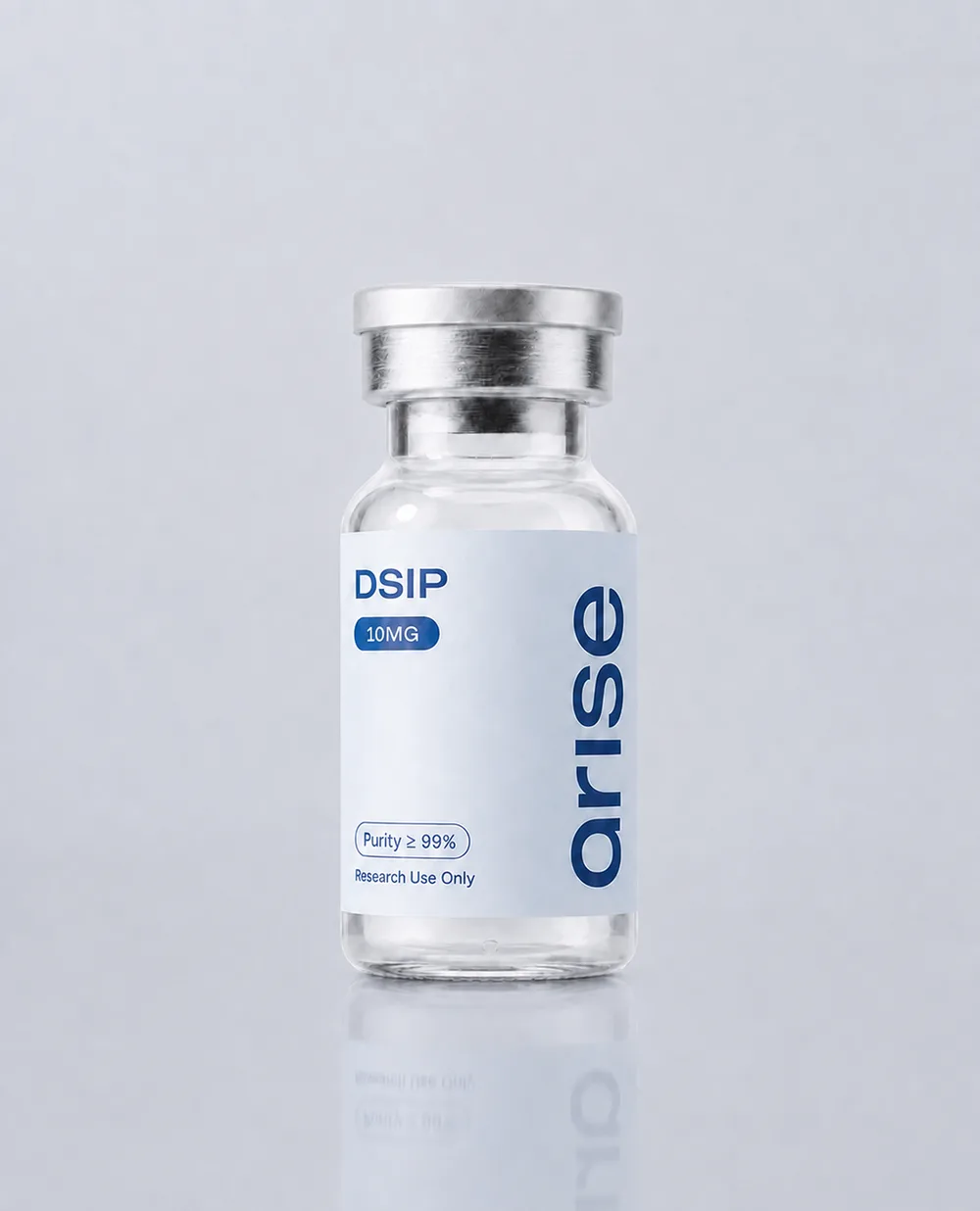
DSIP
10MGDelta sleep-inducing nonapeptide.
6 peer-reviewed citations for this compound
Read the sourcesVolume tiers count vials of this compound at this strength. Mixing different compounds does not combine toward a tier.
- ≥99% purity specification
- Secure checkout
- Ships in 1 business day
- Research use only
Released against a ≥99% HPLC purity specification and supplied as a sealed laboratory reagent for in vitro research use only.
- Type
- Delta sleep-inducing nonapeptide
- CAS number
- 62568-57-4
- Molecular formula
- C35H48N10O15
- Molecular weight
- 848.8 g/mol
- Amino acids
- 9
- Sequence
- Trp-Ala-Gly-Gly-Asp-Ala-Ser-Gly-Glu
- Form
- Lyophilized powder
- Vial strength
- 10MG
- Purity specification
- ≥99% by HPLC
Identifiers are published properties of the molecule. Values we cannot confirm are omitted rather than estimated.
Dispatch
Ships within 1 business day of order confirmation, from the US. Vials ship lyophilized at ambient temperature; move them to the storage condition below on arrival.
Lyophilized
Store at -20°C, protected from light. Stable 24+ months sealed.
Reconstituted
Store at 2-8°C. Use within approximately 30 days.
How DSIP is described to act.
Delta sleep-inducing peptide (DSIP) is a nonapeptide of molecular weight 849, isolated in 1977 from rabbit cerebral venous blood and initially proposed as a humoral sleep-promoting factor. Its mechanism remains unresolved: no DSIP gene, precursor protein or cognate receptor has been isolated, and a 2006 review argues that the sleep hypothesis is poorly documented and that DSIP-like immunoreactivity may reflect one or more distinct, still unidentified peptides, noting that this immunoreactivity is concentrated in neurosecretory hypothalamic nuclei not obviously related to sleep regulation. Reported neuroendocrine actions in rodents include attenuation of corticotropin-releasing-factor-stimulated corticosterone release, apparently at the level of the pituitary, with no effect on release stimulated by ACTH. In rats, the actions of a phosphorylated analogue on sleep architecture and hippocampal CREB phosphorylation were altered by the mu-opioid receptor antagonist naloxone, implicating opioid signalling.
Mechanistic descriptions summarize published in vitro and animal work. They are not a representation of efficacy or safety in any subject, and no administration guidance is given or implied.
The early literature reported that DSIP induced predominantly delta sleep in rabbits, rats and mice and had a more pronounced effect on REM sleep in cats, with U-shaped curves for both dose and infusion time, and that DSIP-like immunoreactivity was detectable in brain, peripheral organs and plasma of several mammals. In rats, intravenous DSIP significantly reduced CRF-stimulated corticosterone levels but did not affect corticosterone released in response to ACTH. In Sprague-Dawley rats subjected to intraluminal middle cerebral artery occlusion, intranasal DSIP administered before occlusion and after reperfusion was associated with significantly better rotarod motor performance, while the accompanying reduction in infarct volume did not reach statistical significance. In rats exposed to chronic hypobaric hypoxia at a simulated altitude of 7620 m, a phosphorylated DSIP analogue increased non-REM and REM sleep and Morris water maze performance and shifted brainstem monoamine levels, tyrosine hydroxylase, MAO-A, GAD and ChAT expression. A double-blind, matched-pairs parallel-groups study in 16 patients with chronic insomnia examined polysomnographic and subjective sleep endpoints and reported higher sleep efficiency and shorter sleep latency versus placebo, but the authors judged these effects weak, possibly attributable to an incidental change in the placebo group, and concluded that short-term DSIP treatment of chronic insomnia is not likely to be of major therapeutic benefit.
Sources & references
Cited literature is provided for scientific reference only and does not constitute a representation of efficacy or safety in any subject. All research findings presented are sourced from peer-reviewed journals and are provided for educational reference only.
- 01Delta Sleep-Inducing Peptide Recovers Motor Function in SD Rats after Focal Stroke
Tukhovskaya EA, et al. · Molecules, 2021
- 02
- 03Delta sleep-inducing peptide (DSIP): a still unresolved riddle
Kovalzon VM, et al. · J Neurochem, 2006
- 04Effects of delta sleep-inducing peptide on sleep of chronic insomniac patients. A double-blind study
Bes F, et al. · Neuropsychobiology, 1992
- 05Delta-sleep-inducing peptide reduces CRF-induced corticosterone release
Graf MV, et al. · Neuroendocrinology, 1985
- 06Delta-sleep-inducing peptide (DSIP): a review
Graf MV, et al. · Neurosci Biobehav Rev, 1984
Every entry links to its record at the publisher or on PubMed. Titles are reproduced exactly as published.
Further searches
Live database searches for DSIP, run against the current index and retrieved independently of this site.
Bench handling, not a dosing guide.
Intended use
Supplied exclusively as a research reagent for in vitro and laboratory use by qualified researchers. Not a drug, dietary supplement, cosmetic or medical device, and not for human or veterinary use. No dosing, route or administration guidance is provided for any compound in this catalog.
Personal protection
Handle in a controlled laboratory environment with gloves and eye protection. Avoid generating or inhaling airborne particulate when opening a vial, and do not handle the material outside a designated work area.
Opening and reconstitution
Lyophilized peptides are hygroscopic. Let the sealed vial equilibrate to room temperature before opening so atmospheric moisture does not condense onto the powder. Reconstitute by directing diluent down the vial wall and swirling until dissolved — do not shake, which shears and foams the peptide.
Stability and aliquoting
Store at -20°C, protected from light. Stable 24+ months sealed. Store at 2-8°C. Use within approximately 30 days. Aliquot reconstituted material and minimize repeated freeze-thaw cycles.
Waste disposal
Dispose of unused material, reconstituted solutions and sharps through your institution's chemical and biological waste stream, in accordance with local regulations. Do not dispose of research material in domestic waste or to drain.
Others in neuro research
Important research notice
Not for human consumption. This product is sold exclusively for research and educational purposes. It is not intended to diagnose, treat, cure, or prevent any disease.
This material is supplied exclusively as a research reagent for in vitro and laboratory use by qualified researchers. It is not a drug, dietary supplement, cosmetic, or medical device, is not intended for human or veterinary use, and is not intended to diagnose, treat, cure, or prevent any disease. No dosing, administration, therapeutic, or benefit claims are made or implied. Cited literature is provided for scientific reference only and does not constitute a representation of efficacy or safety in any subject.
By purchasing this product, you confirm that you are a qualified researcher and will use it in accordance with all applicable laws and regulations.