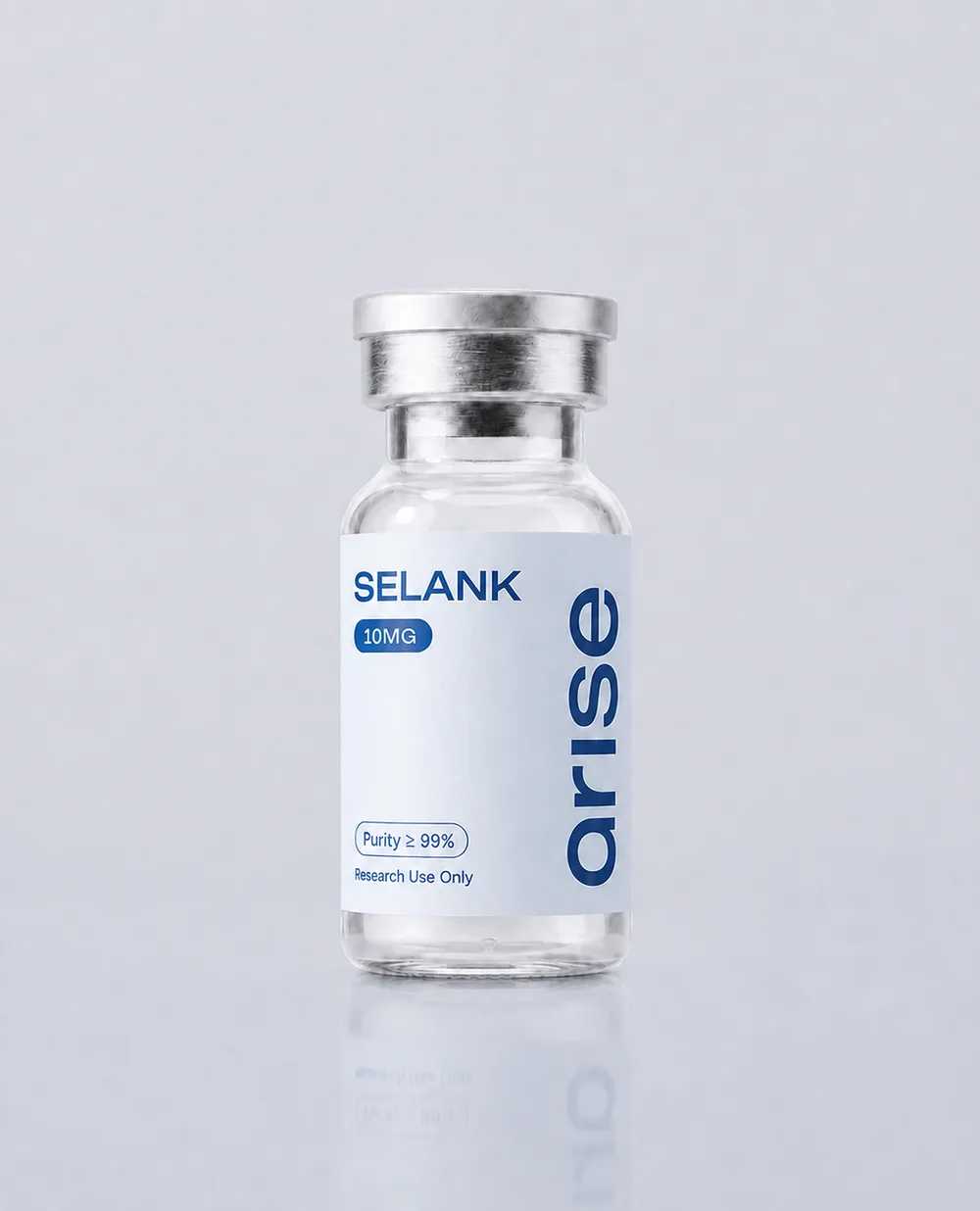
Selank
10MGHeptapeptide tuftsin analog.
12 peer-reviewed citations for this compound
Read the sourcesVolume tiers count vials of this compound at this strength. Mixing different compounds does not combine toward a tier.
- ≥99% purity specification
- Secure checkout
- Ships in 1 business day
- Research use only
Released against a ≥99% HPLC purity specification and supplied as a sealed laboratory reagent for in vitro research use only.
- Type
- Heptapeptide tuftsin analog
- CAS number
- 129954-34-3
- Molecular formula
- C33H57N11O9
- Molecular weight
- 751.87 g/mol
- Amino acids
- 7
- Sequence
- Thr-Lys-Pro-Arg-Pro-Gly-Pro
- Form
- Lyophilized powder
- Vial strength
- 10MG
- Purity specification
- ≥99% by HPLC
Identifiers are published properties of the molecule. Values we cannot confirm are omitted rather than estimated.
Dispatch
Ships within 1 business day of order confirmation, from the US. Vials ship lyophilized at ambient temperature; move them to the storage condition below on arrival.
Lyophilized
Store at -20°C, protected from light. Stable 24+ months sealed.
Reconstituted
Store at 2-8°C. Use within approximately 30 days.
How Selank is described to act.
Selank is a synthetic heptapeptide (Thr-Lys-Pro-Arg-Pro-Gly-Pro) derived from the endogenous tetrapeptide tuftsin by C-terminal Pro-Gly-Pro extension. Radioligand analysis of brain-cell plasma membranes characterised it as a positive allosteric modulator of [3H]GABA binding whose joint action with benzodiazepines is non-cumulative, suggesting binding sites that differ from, but may partially overlap, those of diazepam and olanzapine. A second proposed mechanism is inhibition of enkephalin-degrading enzymes, with the peptide inhibiting enzymatic hydrolysis of plasma enkephalin at an IC50 near 15 microM, more potently than bacitracin or puromycin. In rat hippocampal slices, application increased the amplitude and discharge rate of spontaneous inhibitory postsynaptic currents in CA1 pyramidal neurons.
Mechanistic descriptions summarize published in vitro and animal work. They are not a representation of efficacy or safety in any subject, and no administration guidance is given or implied.
In rat frontal cortex, administration changed the expression of 45 of an 84-gene neurotransmission panel at 1 h and 22 genes at 3 h, and the changes correlated with those produced by GABA itself, which the authors read as allosteric modulation of the GABAergic system. In cultured IMR-32 neuroblastoma cells the peptide alone produced no change in GABAergic gene mRNA levels, but it nearly abolished the expression changes produced by GABA and increased the number of genes altered by olanzapine, interpreted as an effect on GABA-GABAA receptor interaction rather than direct transcriptional regulation. Electrophysiological recordings in rat hippocampal slices showed increased spontaneous inhibitory postsynaptic current amplitude and rate, in some neurons preceded by a transient decrease, without significant dose dependence across 1-8 microM. In blood from patients with anxiety and phobic disorders, shortened enkephalin half-life and reduced enkephalinase activity were observed in generalised anxiety but not in panic disorder or agoraphobia, and the peptide inhibited plasma enkephalin hydrolysis in a concentration-dependent manner in vitro. A clinical study in patients with anxiety-phobic, hypochondriac and somatoform disorders compared phenazepam monotherapy against phenazepam combined with the peptide, assessing endpoints with the HDRS, CGI, Spielberger, UKU, Stroop, verbal fluency and SF-36 instruments. In rats under unpredictable chronic mild stress and in unstressed animals, the peptide and diazepam were assessed individually and in combination on the elevated plus maze, testing whether the peptide alters the action of a classical benzodiazepine. Immunological work in mice examined an 84-gene inflammation panel in spleen at 6 and 24 hours after a single intraperitoneal injection, and a follow-up study tracked C3, Casp1, Il2rg and Xcr1 transcripts from 30 minutes onward, reporting an approximately threefold fall in C3 mRNA at the earliest timepoint. A separate rat study measured BDNF expression in hippocampus after intranasal administration. A medicinal chemistry review of tuftsin and its analogues situates the compound within a wider family of immunomodulatory derivatives. The commercial context is documented directly: preparations seized by customs authorities in 2017 and 2018 were found to contain Selank and Semax, and the analysing laboratory recorded that neither had completed a clinical trial while both circulated as lyophilised powder for injection and in nasal sprays.
Sources & references
Cited literature is provided for scientific reference only and does not constitute a representation of efficacy or safety in any subject. All research findings presented are sourced from peer-reviewed journals and are provided for educational reference only.
- 01
- 02Peptide-based Anxiolytics: The Molecular Aspects of Heptapeptide Selank Biological Activity
Vyunova TV, et al. · Protein Pept Lett, 2018
- 03Effect of Selank on Spontaneous Synaptic Activity of Rat Hippocampal CA1 Neurons
Povarov IS, et al. · Bull Exp Biol Med, 2017
- 04GABA, Selank, and Olanzapine Affect the Expression of Genes Involved in GABAergic Neurotransmission in IMR-32 Cells
Filatova E, et al. · Front Pharmacol, 2017
- 05
- 06Tuftsin - Properties and Analogs
Siebert A, et al. · Curr Med Chem, 2017
- 07Selank Administration Affects the Expression of Some Genes Involved in GABAergic Neurotransmission
Volkova A, et al. · Front Pharmacol, 2016
- 08[Optimization of the treatment of anxiety disorders with selank]
Medvedev VE, et al. · Zh Nevrol Psikhiatr Im S S Korsakova, 2015
- 09The temporary dynamics of inflammation-related genes expression under tuftsin analog Selank action
Kolomin T, et al. · Mol Immunol, 2014
- 10Expression of inflammation-related genes in mouse spleen under tuftsin analog Selank
Kolomin T, et al. · Regul Pept, 2011
- 11Intranasal administration of the peptide Selank regulates BDNF expression in the rat hippocampus in vivo
Inozemtseva LS, et al. · Dokl Biol Sci, 2008
- 12The inhibitory effect of Selank on enkephalin-degrading enzymes as a possible mechanism of its anxiolytic activity
Zozulya AA, et al. · Bull Exp Biol Med, 2001
Every entry links to its record at the publisher or on PubMed. Titles are reproduced exactly as published.
Further searches
Live database searches for Selank, run against the current index and retrieved independently of this site.
Bench handling, not a dosing guide.
Intended use
Supplied exclusively as a research reagent for in vitro and laboratory use by qualified researchers. Not a drug, dietary supplement, cosmetic or medical device, and not for human or veterinary use. No dosing, route or administration guidance is provided for any compound in this catalog.
Personal protection
Handle in a controlled laboratory environment with gloves and eye protection. Avoid generating or inhaling airborne particulate when opening a vial, and do not handle the material outside a designated work area.
Opening and reconstitution
Lyophilized peptides are hygroscopic. Let the sealed vial equilibrate to room temperature before opening so atmospheric moisture does not condense onto the powder. Reconstitute by directing diluent down the vial wall and swirling until dissolved — do not shake, which shears and foams the peptide.
Stability and aliquoting
Store at -20°C, protected from light. Stable 24+ months sealed. Store at 2-8°C. Use within approximately 30 days. Aliquot reconstituted material and minimize repeated freeze-thaw cycles.
Waste disposal
Dispose of unused material, reconstituted solutions and sharps through your institution's chemical and biological waste stream, in accordance with local regulations. Do not dispose of research material in domestic waste or to drain.
Others in neuro research
Important research notice
Not for human consumption. This product is sold exclusively for research and educational purposes. It is not intended to diagnose, treat, cure, or prevent any disease.
This material is supplied exclusively as a research reagent for in vitro and laboratory use by qualified researchers. It is not a drug, dietary supplement, cosmetic, or medical device, is not intended for human or veterinary use, and is not intended to diagnose, treat, cure, or prevent any disease. No dosing, administration, therapeutic, or benefit claims are made or implied. Cited literature is provided for scientific reference only and does not constitute a representation of efficacy or safety in any subject.
By purchasing this product, you confirm that you are a qualified researcher and will use it in accordance with all applicable laws and regulations.