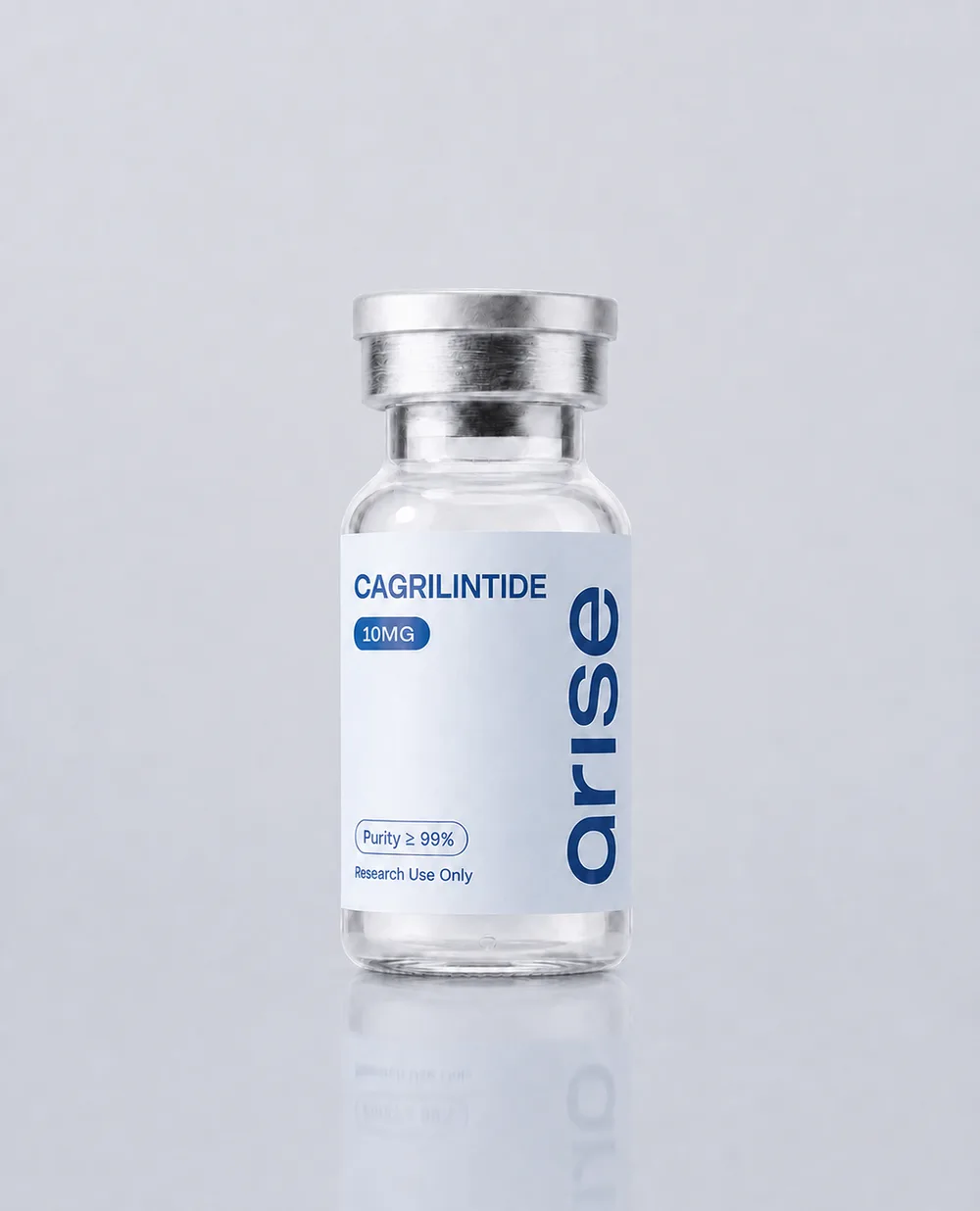
Cagrilintide
10MGLong-acting amylin analog.
6 peer-reviewed citations for this compound
Read the sourcesVolume tiers count vials of this compound at this strength. Mixing different compounds does not combine toward a tier.
- ≥99% purity specification
- Secure checkout
- Ships in 1 business day
- Research use only
Released against a ≥99% HPLC purity specification and supplied as a sealed laboratory reagent for in vitro research use only.
- Type
- Long-acting amylin analog (cagrilintide)
- CAS number
- 1415456-99-3
- Form
- Lyophilized powder
- Vial strength
- 10MG
- Purity specification
- ≥99% by HPLC
Identifiers are published properties of the molecule. Values we cannot confirm are omitted rather than estimated.
Dispatch
Ships within 1 business day of order confirmation, from the US. Vials ship lyophilized at ambient temperature; move them to the storage condition below on arrival.
Lyophilized
Store at -20°C, protected from light. Stable 24+ months sealed.
Reconstituted
Store at 2-8°C. Use within approximately 30 days.
How Cagrilintide is described to act.
Cagrilintide (AM833) is a lipidated, long-acting analogue of the pancreatic hormone amylin, engineered to resist the amyloid fibril formation that makes native amylin a difficult drug-design target. Pharmacological profiling across 25 endpoints in vitro characterised it as a non-selective agonist at amylin receptors, which are heterodimers of the calcitonin G protein-coupled receptor with receptor activity-modifying proteins, and which also independently activates the calcitonin receptor; this produces a binding and activation profile distinct from selective amylin receptor agonists such as pramlintide. Native amylin is described in this literature as a pancreatic hormone that induces satiety, with amylin receptor agonism discussed as complementary to GLP-1 receptor agonism. In rats, roughly one third of the weight loss produced by an amylin plus GLP-1 analogue combination was attributed to blunting of metabolic adaptation rather than to reduced energy intake alone.
Mechanistic descriptions summarize published in vitro and animal work. They are not a representation of efficacy or safety in any subject, and no administration guidance is given or implied.
Medicinal chemistry work described the structure-activity effort behind the selection of cagrilintide from a series of stable lipidated amylin analogues. A multicentre, randomised, double-blind, placebo- and active-controlled dose-finding phase 2 trial in adults with overweight or obesity and without diabetes assessed the dose-response relationship for change in bodyweight, safety and tolerability across a 26-week treatment period. A randomised, placebo-controlled phase 1b multiple-ascending-dose trial in otherwise healthy participants with a body-mass index of 27.0-39.9 kg/m2 took the number of treatment-emergent adverse events as its primary endpoint, with pharmacokinetic measures as secondary endpoints, when cagrilintide and semaglutide were co-administered. A 32-week phase 2 trial in adults with type 2 diabetes took change from baseline in glycated haemoglobin as the primary endpoint, with bodyweight, fasting plasma glucose and continuous glucose monitoring parameters as secondary endpoints. In rats, the combination reduced food intake and produced weight loss that pair-feeding did not fully reproduce, which the authors attributed to preserved energy expenditure.
Sources & references
Cited literature is provided for scientific reference only and does not constitute a representation of efficacy or safety in any subject. All research findings presented are sourced from peer-reviewed journals and are provided for educational reference only.
- 01CagriSema drives weight loss in rats by reducing energy intake and preserving energy expenditure
Jacobsen JM, et al. · Nat Metab, 2025
- 02
- 03Development of Cagrilintide, a Long-Acting Amylin Analogue
Kruse T, et al. · J Med Chem, 2021
- 04AM833 Is a Novel Agonist of Calcitonin Family G Protein-Coupled Receptors: Pharmacological Comparison with Six Selective and Nonselective Agonists
Fletcher MM, et al. · J Pharmacol Exp Ther, 2021
- 05
- 06
Every entry links to its record at the publisher or on PubMed. Titles are reproduced exactly as published.
Further searches
Live database searches for Cagrilintide, run against the current index and retrieved independently of this site.
Bench handling, not a dosing guide.
Intended use
Supplied exclusively as a research reagent for in vitro and laboratory use by qualified researchers. Not a drug, dietary supplement, cosmetic or medical device, and not for human or veterinary use. No dosing, route or administration guidance is provided for any compound in this catalog.
Personal protection
Handle in a controlled laboratory environment with gloves and eye protection. Avoid generating or inhaling airborne particulate when opening a vial, and do not handle the material outside a designated work area.
Opening and reconstitution
Lyophilized peptides are hygroscopic. Let the sealed vial equilibrate to room temperature before opening so atmospheric moisture does not condense onto the powder. Reconstitute by directing diluent down the vial wall and swirling until dissolved — do not shake, which shears and foams the peptide.
Stability and aliquoting
Store at -20°C, protected from light. Stable 24+ months sealed. Store at 2-8°C. Use within approximately 30 days. Aliquot reconstituted material and minimize repeated freeze-thaw cycles.
Waste disposal
Dispose of unused material, reconstituted solutions and sharps through your institution's chemical and biological waste stream, in accordance with local regulations. Do not dispose of research material in domestic waste or to drain.
Others in metabolic research
5-Amino 1MQ
Small-molecule methylquinolinium research compound.
AOD-9604
HGH fragment 176-191 analog.
MOTS-C
16-residue mitochondrial-derived peptide.
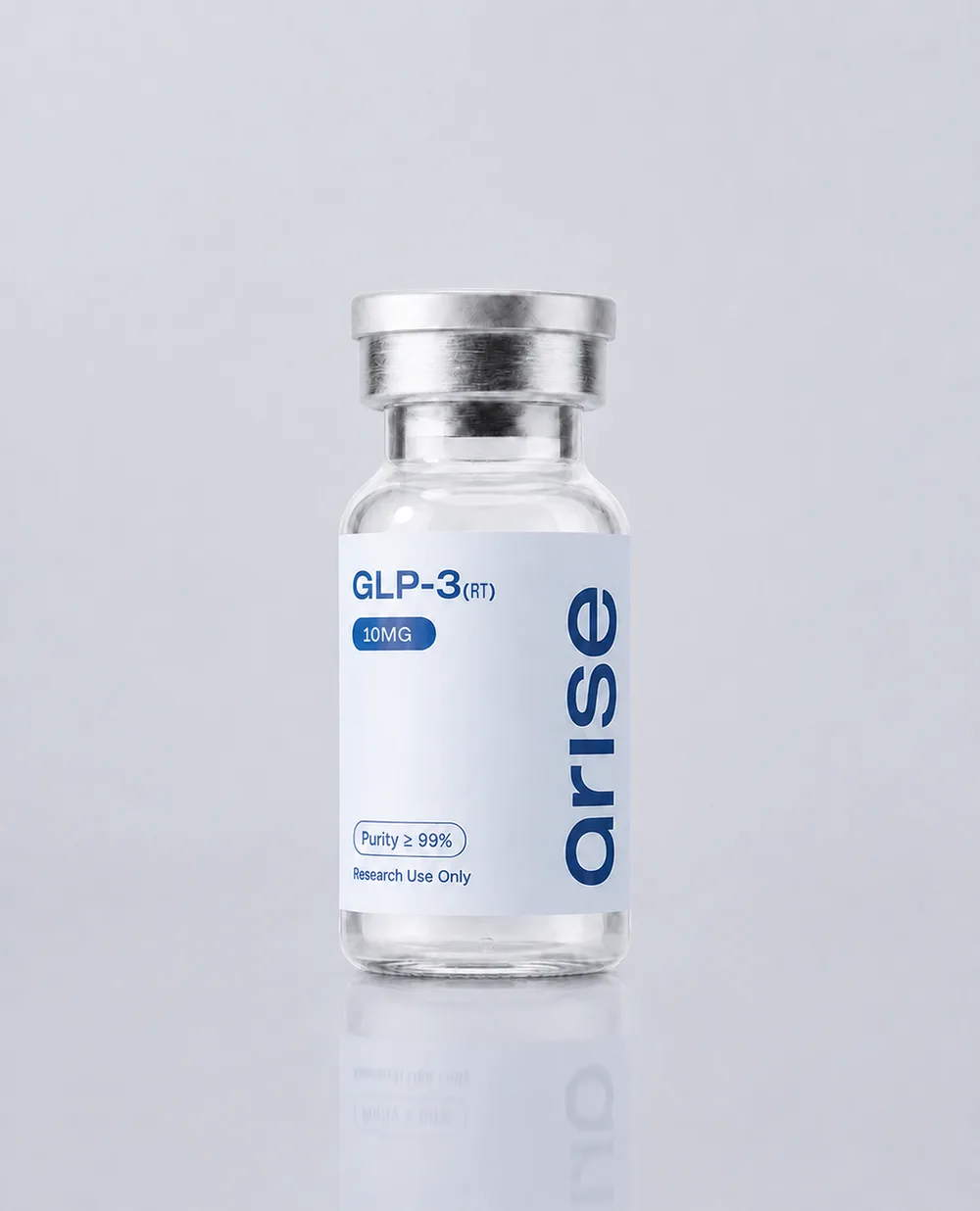
GLP-3(rt)
Triple GIP/GLP-1/glucagon receptor agonist.
Important research notice
Not for human consumption. This product is sold exclusively for research and educational purposes. It is not intended to diagnose, treat, cure, or prevent any disease.
This material is supplied exclusively as a research reagent for in vitro and laboratory use by qualified researchers. It is not a drug, dietary supplement, cosmetic, or medical device, is not intended for human or veterinary use, and is not intended to diagnose, treat, cure, or prevent any disease. No dosing, administration, therapeutic, or benefit claims are made or implied. Cited literature is provided for scientific reference only and does not constitute a representation of efficacy or safety in any subject.
By purchasing this product, you confirm that you are a qualified researcher and will use it in accordance with all applicable laws and regulations.