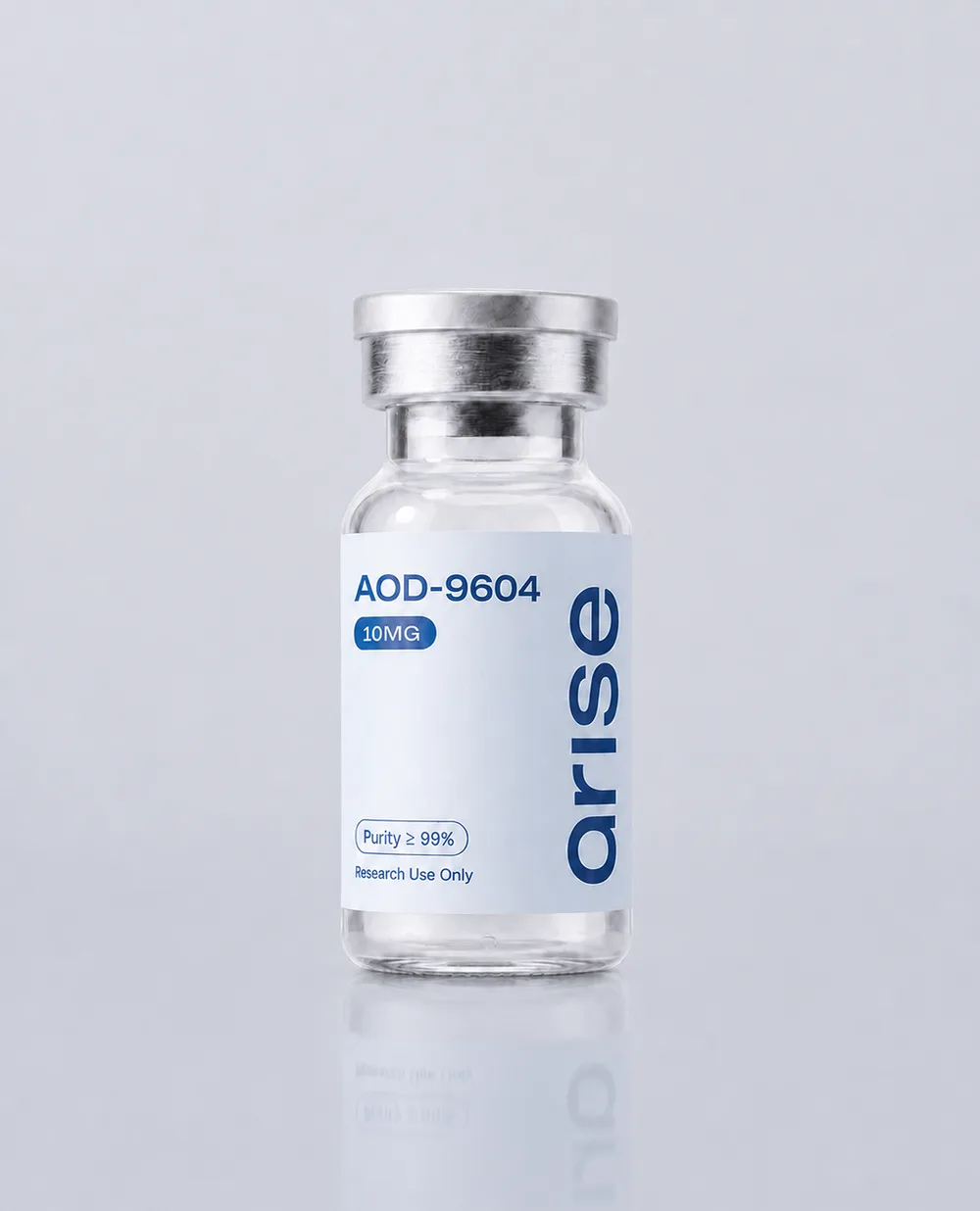
AOD-9604
10MGHGH fragment 176-191 analog.
6 peer-reviewed citations for this compound
Read the sourcesVolume tiers count vials of this compound at this strength. Mixing different compounds does not combine toward a tier.
- ≥99% purity specification
- Secure checkout
- Ships in 1 business day
- Research use only
Released against a ≥99% HPLC purity specification and supplied as a sealed laboratory reagent for in vitro research use only.
- Type
- HGH fragment analog
- CAS number
- 221231-10-3
- Molecular formula
- C78H123N23O23S2
- Molecular weight
- 1815.1 g/mol
- Amino acids
- 16
- Form
- Lyophilized powder
- Vial strength
- 10MG
- Purity specification
- ≥99% by HPLC
Identifiers are published properties of the molecule. Values we cannot confirm are omitted rather than estimated.
Dispatch
Ships within 1 business day of order confirmation, from the US. Vials ship lyophilized at ambient temperature; move them to the storage condition below on arrival.
Lyophilized
Store at -20°C, protected from light. Stable 24+ months sealed.
Reconstituted
Store at 2-8°C. Use within approximately 30 days.
How AOD-9604 is described to act.
AOD9604 is a synthetic peptide corresponding to the C-terminal 177-191 region of human growth hormone with an additional tyrosine residue at the N-terminus. In vitro work reported that the fragment does not compete for the human growth hormone receptor and does not induce receptor-mediated cell proliferation, distinguishing it pharmacologically from the intact hormone. In rodent and human adipose tissue the reported actions are antilipogenic and, in several preparations, lipolytic, with early peptide chemistry assigning the antilipogenic domain of human growth hormone to this C-terminal sequence. Experiments in beta(3)-adrenergic receptor knockout mice indicated that the chronic effects on body weight and lipolysis depend on an intact beta(3)-adrenergic pathway, while acute increases in energy expenditure and fat oxidation were still observed in the knockouts.
Mechanistic descriptions summarize published in vitro and animal work. They are not a representation of efficacy or safety in any subject, and no administration guidance is given or implied.
Across obese rodent models, chronic administration of the fragment was reported to reduce body weight gain while increasing adipose lipolytic activity, in vivo fat oxidation and plasma glycerol. In obese Zucker rats, chronic treatment was reported not to impair insulin sensitivity as assessed by euglycaemic clamp, and in ob/ob mice the fragment did not induce the hyperglycaemia or reduced insulin secretion observed with intact human growth hormone in the same experiments. Studies of the closely related AOD-9401 sequence reported reduced lipogenic and increased lipolytic activity in adipose tissue isolated from obese rodents and from humans ex vivo, with no difference in food consumption between groups. Early work on the synthetic hGH 177-191 sequence found antilipogenic activity comparable to that of the intact hormone but no significant lipolytic effect as measured by glycerol release from rat epididymal fat pads. Analytical chemistry work characterised six candidate in vitro metabolites, identified one comparatively stable serum metabolite, and validated a urine detection method, reflecting the peptide's status as a substance prohibited by the World Anti-Doping Agency.
Sources & references
Cited literature is provided for scientific reference only and does not constitute a representation of efficacy or safety in any subject. All research findings presented are sourced from peer-reviewed journals and are provided for educational reference only.
- 01Detection and in vitro metabolism of AOD9604
Cox HD, et al. · Drug Test Anal, 2015
- 02Increase of fat oxidation and weight loss in obese mice caused by chronic treatment with human growth hormone or a modified C-terminal fragment
Heffernan MA, et al. · Int J Obes Relat Metab Disord, 2001
- 03
- 04Metabolic studies of a synthetic lipolytic domain (AOD9604) of human growth hormone
Ng FM, et al. · Horm Res, 2000
- 05Effects of oral administration of a synthetic fragment of human growth hormone on lipid metabolism
Heffernan MA, et al. · Am J Physiol Endocrinol Metab, 2000
- 06Antilipogenic action of synthetic C-terminal sequence 177-191 of human growth hormone
Wu Z, et al. · Biochem Mol Biol Int, 1993
Every entry links to its record at the publisher or on PubMed. Titles are reproduced exactly as published.
Further searches
Live database searches for AOD-9604, run against the current index and retrieved independently of this site.
Bench handling, not a dosing guide.
Intended use
Supplied exclusively as a research reagent for in vitro and laboratory use by qualified researchers. Not a drug, dietary supplement, cosmetic or medical device, and not for human or veterinary use. No dosing, route or administration guidance is provided for any compound in this catalog.
Personal protection
Handle in a controlled laboratory environment with gloves and eye protection. Avoid generating or inhaling airborne particulate when opening a vial, and do not handle the material outside a designated work area.
Opening and reconstitution
Lyophilized peptides are hygroscopic. Let the sealed vial equilibrate to room temperature before opening so atmospheric moisture does not condense onto the powder. Reconstitute by directing diluent down the vial wall and swirling until dissolved — do not shake, which shears and foams the peptide.
Stability and aliquoting
Store at -20°C, protected from light. Stable 24+ months sealed. Store at 2-8°C. Use within approximately 30 days. Aliquot reconstituted material and minimize repeated freeze-thaw cycles.
Waste disposal
Dispose of unused material, reconstituted solutions and sharps through your institution's chemical and biological waste stream, in accordance with local regulations. Do not dispose of research material in domestic waste or to drain.
Others in metabolic research
5-Amino 1MQ
Small-molecule methylquinolinium research compound.
Cagrilintide
Long-acting amylin analog.
MOTS-C
16-residue mitochondrial-derived peptide.
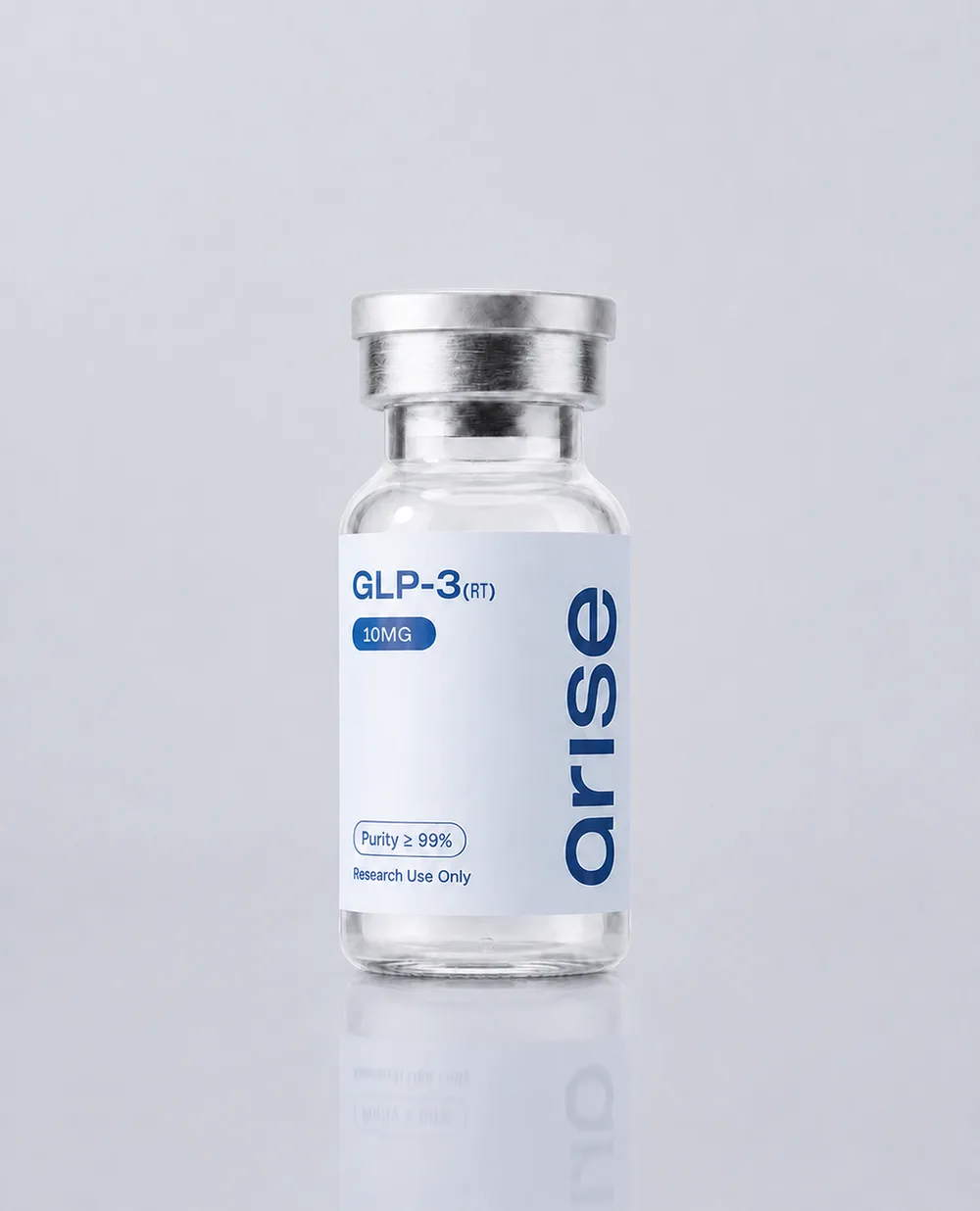
GLP-3(rt)
Triple GIP/GLP-1/glucagon receptor agonist.
Important research notice
Not for human consumption. This product is sold exclusively for research and educational purposes. It is not intended to diagnose, treat, cure, or prevent any disease.
This material is supplied exclusively as a research reagent for in vitro and laboratory use by qualified researchers. It is not a drug, dietary supplement, cosmetic, or medical device, is not intended for human or veterinary use, and is not intended to diagnose, treat, cure, or prevent any disease. No dosing, administration, therapeutic, or benefit claims are made or implied. Cited literature is provided for scientific reference only and does not constitute a representation of efficacy or safety in any subject.
By purchasing this product, you confirm that you are a qualified researcher and will use it in accordance with all applicable laws and regulations.