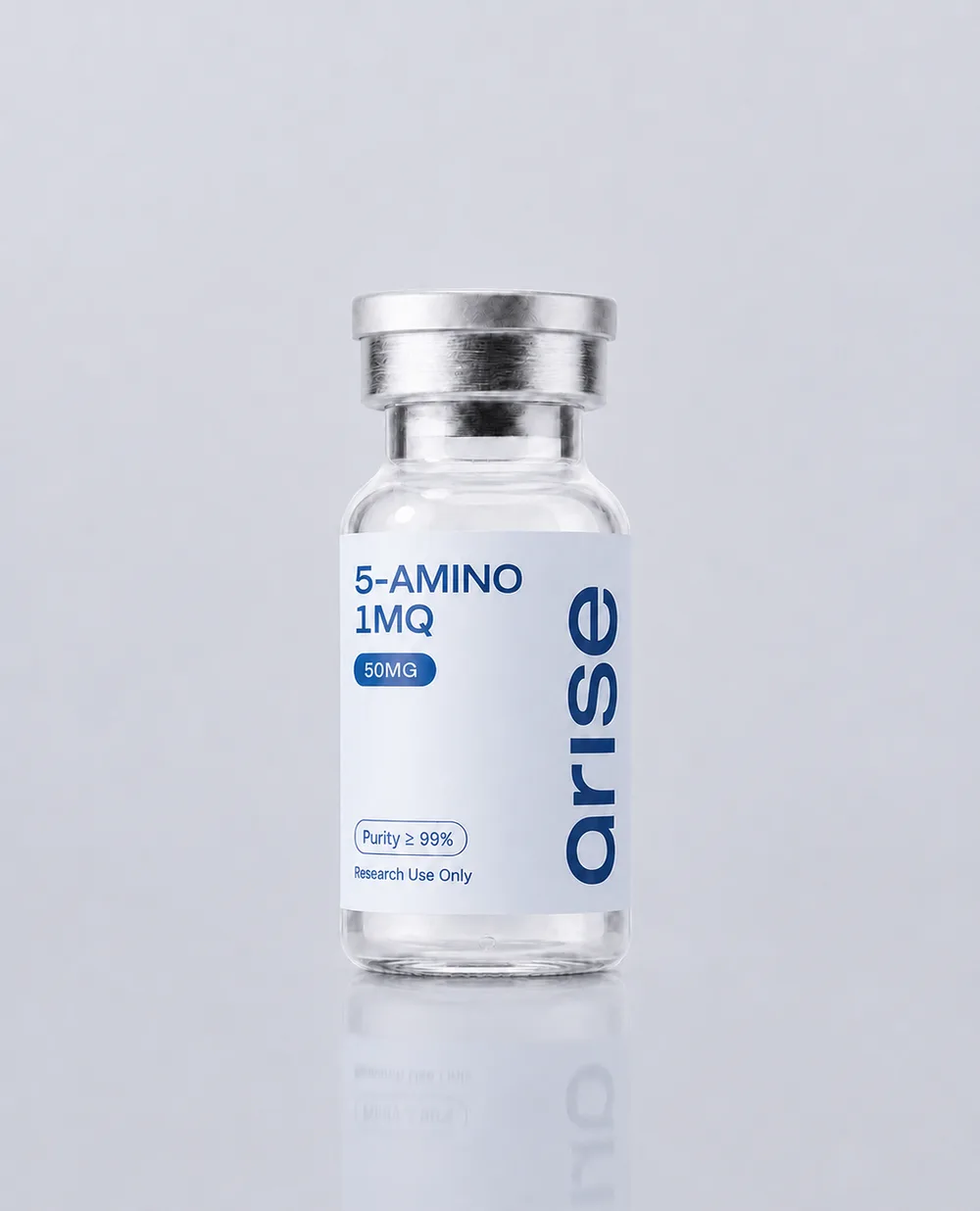
5-Amino 1MQ
50MGSmall-molecule methylquinolinium research compound.
6 peer-reviewed citations for this compound
Read the sourcesVolume tiers count vials of this compound at this strength. Mixing different compounds does not combine toward a tier.
- ≥99% purity specification
- Secure checkout
- Ships in 1 business day
- Research use only
Released against a ≥99% HPLC purity specification and supplied as a sealed laboratory reagent for in vitro research use only.
- Type
- Small-molecule methylquinolinium
- Form
- Lyophilized powder
- Vial strength
- 50MG
- Purity specification
- ≥99% by HPLC
Identifiers are published properties of the molecule. Values we cannot confirm are omitted rather than estimated.
Dispatch
Ships within 1 business day of order confirmation, from the US. Vials ship lyophilized at ambient temperature; move them to the storage condition below on arrival.
Lyophilized
Store at -20°C, protected from light. Stable 24+ months sealed.
Reconstituted
Store at 2-8°C. Use within approximately 30 days.
How 5-Amino 1MQ is described to act.
5-Amino-1-methylquinolinium (5-amino-1MQ, 5A1MQ, 5-AMQ) is a small-molecule, membrane-permeable inhibitor of nicotinamide N-methyltransferase (NNMT), the cytosolic enzyme that transfers a methyl group from S-adenosyl-L-methionine to nicotinamide to form 1-methylnicotinamide. Structure-activity work screening N-methylated quinolinium, isoquinolinium, pyridinium and benzimidazolium/benzothiazolium analogues identified quinoliniums as a scaffold reaching low-micromolar IC50 values, with computational docking placing them at the NNMT nicotinamide substrate-binding site. Because nicotinamide is the entry substrate of the NAD+ salvage pathway, NNMT inhibition is described in this literature as intersecting with NAD+ salvage flux and sirtuin 1 activity. NNMT is reported to be overexpressed in adipose tissue and skeletal muscle in rodent obesity and aging models, which is the stated rationale for targeting it in those tissues.
Mechanistic descriptions summarize published in vitro and animal work. They are not a representation of efficacy or safety in any subject, and no administration guidance is given or implied.
In diet-induced obese mice, once-daily 5A1MQ over 28 days dose-dependently limited body weight and fat mass gain, altered oral glucose tolerance and insulin measures, and attenuated hepatic steatosis, macrophage infiltration, liver weight and hepatic triglycerides on histology, with plasma and tissue pharmacokinetics characterized after intravenous, oral and subcutaneous dosing. An earlier report in the same series characterized membrane permeability by parallel artificial membrane permeability and Caco-2 assays, selectivity against structurally related methyltransferases and NAD+ salvage pathway enzymes, and effects on lipogenesis and intracellular 1-methylnicotinamide in cultured adipocytes before testing in diet-induced obese mice. In 24-month-old mice, NNMT inhibitor treatment was reported to activate senescent muscle stem cells and increase regenerative capacity after injury, and a separate study in 22-to-24-month-old mice compared NNMT inhibition, intensive exercise and their combination across grip strength, longitudinal running capacity, plantarflexor peak torque, fibre cross-sectional area and intramyocellular lipid, with proteome and metabolome profiling. A validated LC-MS/MS assay was developed to quantify 5-AMQ in rat plasma and urine for pharmacokinetic and oral bioavailability determination. The literature on this compound is small and, within this citation set, entirely preclinical and in vitro; no human clinical trial is represented.
Sources & references
Cited literature is provided for scientific reference only and does not constitute a representation of efficacy or safety in any subject. All research findings presented are sourced from peer-reviewed journals and are provided for educational reference only.
- 01Nicotinamide N-methyltransferase inhibition mitigates obesity-related metabolic dysfunction
Babula JJ, et al. · Diabetes Obes Metab, 2024
- 02
- 03
- 04
- 05Selective and membrane-permeable small molecule inhibitors of nicotinamide N-methyltransferase reverse high fat diet-induced obesity in mice
Neelakantan H, et al. · Biochem Pharmacol, 2018
- 06Structure-Activity Relationship for Small Molecule Inhibitors of Nicotinamide N-Methyltransferase
Neelakantan H, et al. · J Med Chem, 2017
Every entry links to its record at the publisher or on PubMed. Titles are reproduced exactly as published.
Further searches
Live database searches for 5-Amino 1MQ, run against the current index and retrieved independently of this site.
Bench handling, not a dosing guide.
Intended use
Supplied exclusively as a research reagent for in vitro and laboratory use by qualified researchers. Not a drug, dietary supplement, cosmetic or medical device, and not for human or veterinary use. No dosing, route or administration guidance is provided for any compound in this catalog.
Personal protection
Handle in a controlled laboratory environment with gloves and eye protection. Avoid generating or inhaling airborne particulate when opening a vial, and do not handle the material outside a designated work area.
Opening and reconstitution
Lyophilized peptides are hygroscopic. Let the sealed vial equilibrate to room temperature before opening so atmospheric moisture does not condense onto the powder. Reconstitute by directing diluent down the vial wall and swirling until dissolved — do not shake, which shears and foams the peptide.
Stability and aliquoting
Store at -20°C, protected from light. Stable 24+ months sealed. Store at 2-8°C. Use within approximately 30 days. Aliquot reconstituted material and minimize repeated freeze-thaw cycles.
Waste disposal
Dispose of unused material, reconstituted solutions and sharps through your institution's chemical and biological waste stream, in accordance with local regulations. Do not dispose of research material in domestic waste or to drain.
Others in metabolic research
AOD-9604
HGH fragment 176-191 analog.
Cagrilintide
Long-acting amylin analog.
MOTS-C
16-residue mitochondrial-derived peptide.
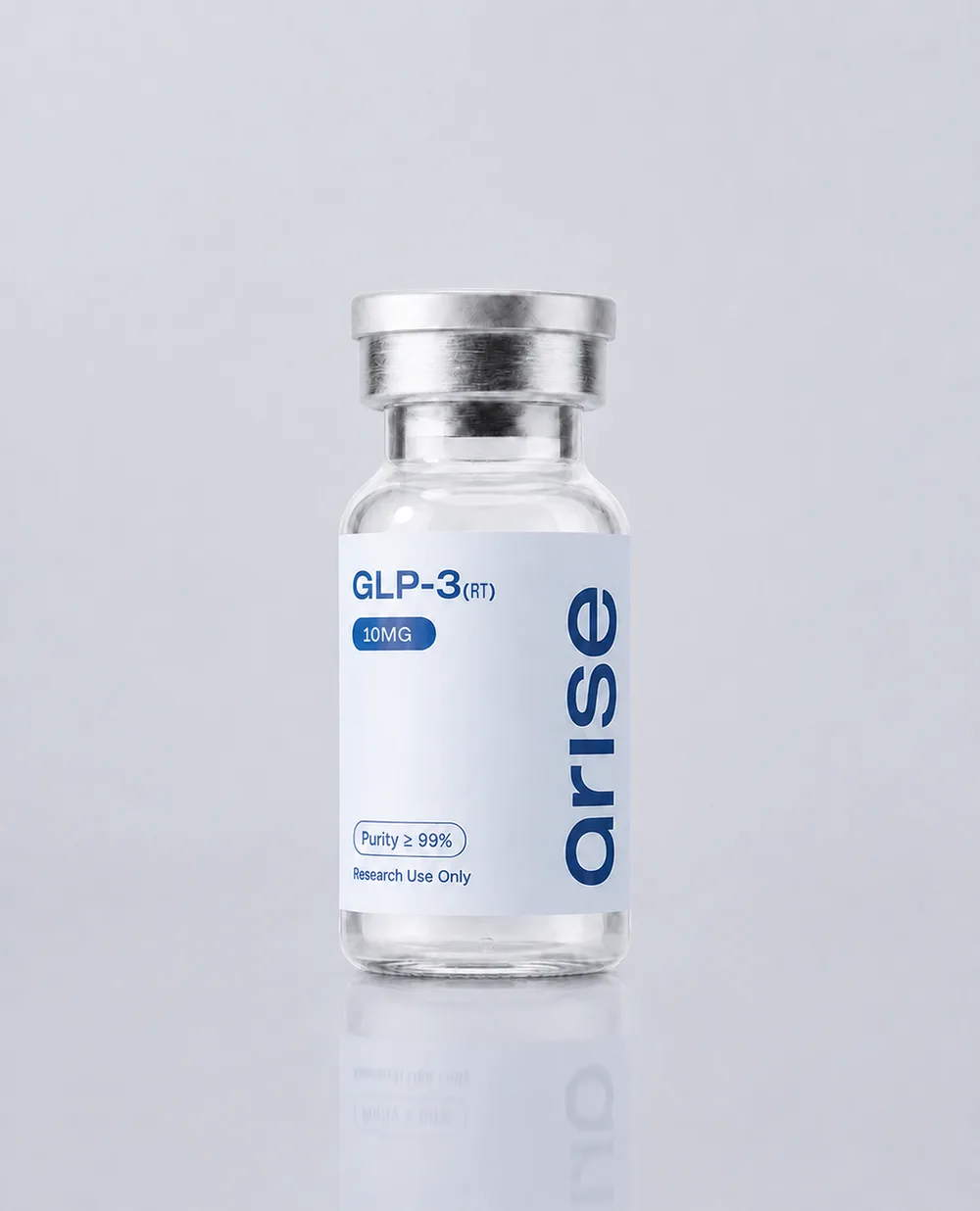
GLP-3(rt)
Triple GIP/GLP-1/glucagon receptor agonist.
Important research notice
Not for human consumption. This product is sold exclusively for research and educational purposes. It is not intended to diagnose, treat, cure, or prevent any disease.
This material is supplied exclusively as a research reagent for in vitro and laboratory use by qualified researchers. It is not a drug, dietary supplement, cosmetic, or medical device, is not intended for human or veterinary use, and is not intended to diagnose, treat, cure, or prevent any disease. No dosing, administration, therapeutic, or benefit claims are made or implied. Cited literature is provided for scientific reference only and does not constitute a representation of efficacy or safety in any subject.
By purchasing this product, you confirm that you are a qualified researcher and will use it in accordance with all applicable laws and regulations.