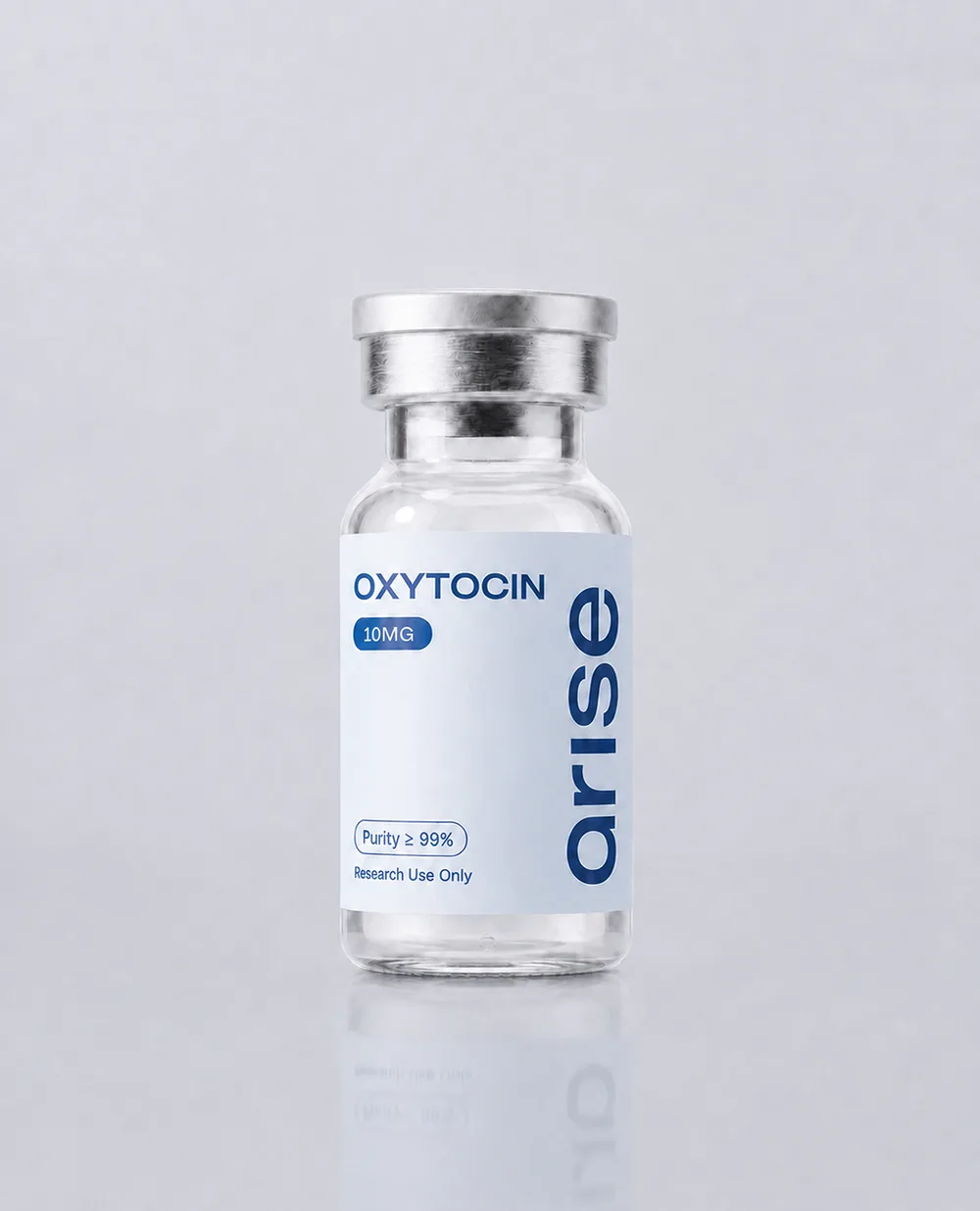
Oxytocin
10MGCyclic nonapeptide with disulfide bridge.
6 peer-reviewed citations for this compound
Read the sourcesVolume tiers count vials of this compound at this strength. Mixing different compounds does not combine toward a tier.
- ≥99% purity specification
- Secure checkout
- Ships in 1 business day
- Research use only
Released against a ≥99% HPLC purity specification and supplied as a sealed laboratory reagent for in vitro research use only.
- Type
- Cyclic nonapeptide with intramolecular disulfide bridge
- CAS number
- 50-56-6
- Molecular formula
- C43H66N12O12S2
- Molecular weight
- 1007.19 g/mol
- Amino acids
- 9
- Form
- Lyophilized powder
- Vial strength
- 10MG
- Purity specification
- ≥99% by HPLC
Identifiers are published properties of the molecule. Values we cannot confirm are omitted rather than estimated.
Dispatch
Ships within 1 business day of order confirmation, from the US. Vials ship lyophilized at ambient temperature; move them to the storage condition below on arrival.
Lyophilized
Store at -20°C, protected from light. Stable 24+ months sealed.
Reconstituted
Store at 2-8°C. Use within approximately 30 days.
How Oxytocin is described to act.
Oxytocin is a nonapeptide expressed chiefly in magnocellular neurons of the hypothalamic paraventricular and supraoptic nuclei and released from the posterior pituitary, with additional synthesis in peripheral tissues including uterus, placenta, amnion, corpus luteum, testis and heart. It signals through a single receptor, OXTR, a class I rhodopsin-type G protein-coupled receptor that couples principally via Gq proteins to phospholipase C-beta and can also engage Gi; the high-affinity receptor state requires Mg2+ and cholesterol, which appear to act as allosteric modulators, and the agonist-binding region is distinct from the antagonist site. Receptor activation raises intracellular calcium through inositol trisphosphate-mediated store release, store-operated entry and voltage-operated entry, and also acts through calcium-independent calcium sensitisation in smooth muscle. In neurons, OXTR activates MAPK, PKC, PLC and CaMK cascades converging on transcription factors such as CREB and MEF-2, with receptor expression, desensitisation and trafficking described as key determinants of signal magnitude and duration.
Mechanistic descriptions summarize published in vitro and animal work. They are not a representation of efficacy or safety in any subject, and no administration guidance is given or implied.
Reviews of the receptor system document strongly steroid-dependent regulation of OXTR function and mutagenesis- and modelling-based mapping of separate agonist and antagonist binding regions. In the myometrium, receptor activation drives contraction through the calcium mechanisms above, and both OXTR agonists and antagonists have been developed and evaluated as obstetric agents in the settings of dysfunctional labour, postpartum haemorrhage and preterm birth. In mice, oxytocin acting in the nucleus accumbens core elicited a presynaptically expressed long-term depression of excitatory transmission onto medium spiny neurons, and genetic deletion of oxytocin receptors specifically from dorsal raphe serotonergic inputs abolished the reinforcing properties of social interaction, an effect that also required accumbal 5-HT1B receptors. Circuit-level studies in rodents, including prairie voles, indicate that oxytocin can increase the salience of social stimuli and raise signal-to-noise ratios by modulating spiking and synaptic plasticity. Reviews note that oxytocin and OXT-derived analogues have been proposed as candidate treatments for neuropsychiatric conditions involving social deficits, while emphasising that the cellular and molecular pharmacology of the receptor in neuronal and glial cells remains incompletely characterised.
Sources & references
Cited literature is provided for scientific reference only and does not constitute a representation of efficacy or safety in any subject. All research findings presented are sourced from peer-reviewed journals and are provided for educational reference only.
- 01Oxytocin, Neural Plasticity, and Social Behavior
Froemke RC, et al. · Annu Rev Neurosci, 2021
- 02Molecular Basis of Oxytocin Receptor Signalling in the Brain: What We Know and What We Need to Know
Busnelli M, et al. · Curr Top Behav Neurosci, 2018
- 03The Oxytocin Receptor: From Intracellular Signaling to Behavior
Jurek B, et al. · Physiol Rev, 2018
- 04Oxytocin: its mechanism of action and receptor signalling in the myometrium
Arrowsmith S, et al. · J Neuroendocrinol, 2014
- 05
- 06The oxytocin receptor system: structure, function, and regulation
Gimpl G, et al. · Physiol Rev, 2001
Every entry links to its record at the publisher or on PubMed. Titles are reproduced exactly as published.
Further searches
Live database searches for Oxytocin, run against the current index and retrieved independently of this site.
Bench handling, not a dosing guide.
Intended use
Supplied exclusively as a research reagent for in vitro and laboratory use by qualified researchers. Not a drug, dietary supplement, cosmetic or medical device, and not for human or veterinary use. No dosing, route or administration guidance is provided for any compound in this catalog.
Personal protection
Handle in a controlled laboratory environment with gloves and eye protection. Avoid generating or inhaling airborne particulate when opening a vial, and do not handle the material outside a designated work area.
Opening and reconstitution
Lyophilized peptides are hygroscopic. Let the sealed vial equilibrate to room temperature before opening so atmospheric moisture does not condense onto the powder. Reconstitute by directing diluent down the vial wall and swirling until dissolved — do not shake, which shears and foams the peptide.
Stability and aliquoting
Store at -20°C, protected from light. Stable 24+ months sealed. Store at 2-8°C. Use within approximately 30 days. Aliquot reconstituted material and minimize repeated freeze-thaw cycles.
Waste disposal
Dispose of unused material, reconstituted solutions and sharps through your institution's chemical and biological waste stream, in accordance with local regulations. Do not dispose of research material in domestic waste or to drain.
Others in wellness research
Admax
Research peptide preparation, lyophilized.
Kisspeptin
Kisspeptin-10 decapeptide.
LL-37
37-residue cathelicidin-derived peptide.
PT-141
Bremelanotide, cyclic heptapeptide analog.
Important research notice
Not for human consumption. This product is sold exclusively for research and educational purposes. It is not intended to diagnose, treat, cure, or prevent any disease.
This material is supplied exclusively as a research reagent for in vitro and laboratory use by qualified researchers. It is not a drug, dietary supplement, cosmetic, or medical device, is not intended for human or veterinary use, and is not intended to diagnose, treat, cure, or prevent any disease. No dosing, administration, therapeutic, or benefit claims are made or implied. Cited literature is provided for scientific reference only and does not constitute a representation of efficacy or safety in any subject.
By purchasing this product, you confirm that you are a qualified researcher and will use it in accordance with all applicable laws and regulations.