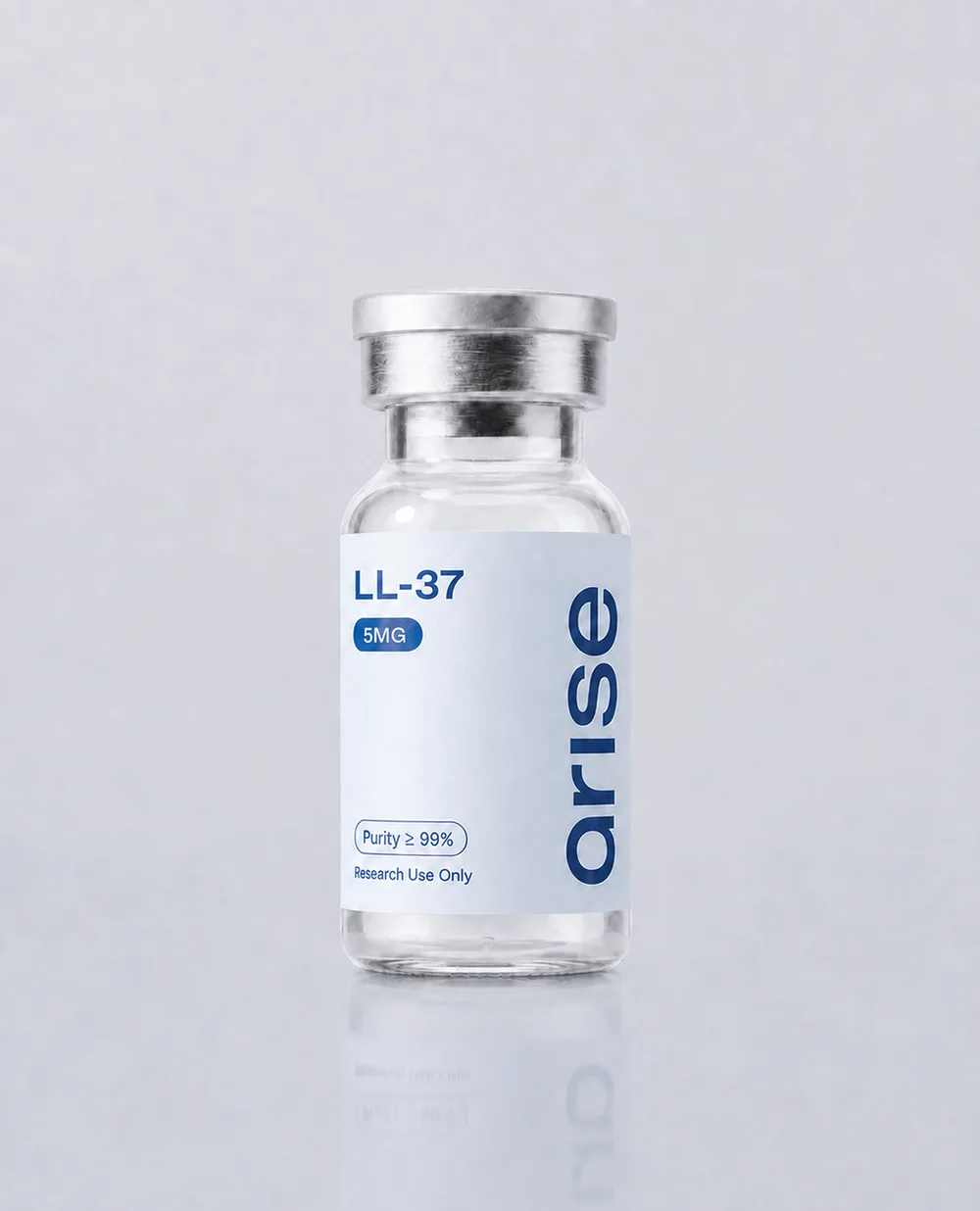
LL-37
5MG37-residue cathelicidin-derived peptide.
6 peer-reviewed citations for this compound
Read the sourcesVolume tiers count vials of this compound at this strength. Mixing different compounds does not combine toward a tier.
- ≥99% purity specification
- Secure checkout
- Ships in 1 business day
- Research use only
Released against a ≥99% HPLC purity specification and supplied as a sealed laboratory reagent for in vitro research use only.
- Type
- Cathelicidin-derived antimicrobial peptide
- CAS number
- 154947-66-7
- Amino acids
- 37
- Form
- Lyophilized powder
- Vial strength
- 5MG
- Purity specification
- ≥99% by HPLC
Identifiers are published properties of the molecule. Values we cannot confirm are omitted rather than estimated.
Dispatch
Ships within 1 business day of order confirmation, from the US. Vials ship lyophilized at ambient temperature; move them to the storage condition below on arrival.
Lyophilized
Store at -20°C, protected from light. Stable 24+ months sealed.
Reconstituted
Store at 2-8°C. Use within approximately 30 days.
How LL-37 is described to act.
LL-37 is the 37-residue carboxy-terminal peptide cleaved from human cathelicidin hCAP18, produced by neutrophils and by various epithelial cells. Solid-state NMR of site-specifically labelled peptide in oriented lipid bilayers places the amphipathic helix parallel to the membrane surface and supports a toroidal-pore model of bilayer disruption, ruling out barrel-stave and detergent-like mechanisms in those systems. Independently of direct membrane activity, LL-37 is chemotactic for human monocytes, neutrophils and T lymphocytes and mobilizes calcium through the G-protein-coupled formyl peptide receptor-like 1 (FPRL1). It also complexes extracellular self-DNA into a form that engages endosomal TLR9 in plasmacytoid dendritic cells.
Mechanistic descriptions summarize published in vitro and animal work. They are not a representation of efficacy or safety in any subject, and no administration guidance is given or implied.
In radial diffusion and broth microdilution assays LL-37 showed MICs below 10 microgram/mL against Pseudomonas aeruginosa, Salmonella typhimurium, Escherichia coli, Listeria monocytogenes, staphylococci and vancomycin-resistant enterococci even in media containing 100 mM NaCl, but methicillin-resistant S. aureus, Proteus mirabilis and Candida albicans were resistant at that salt concentration and susceptible only in low-salt media. Cathelicidin-deficient mice were more susceptible to invasive group A streptococcal skin infection than wild-type animals, establishing an in vivo requirement for the peptide family in that model. In psoriatic skin, LL-37 bound to self-DNA converts it into a trigger for type I interferon production by plasmacytoid dendritic cells, a mechanism framed as driving autoimmune inflammation rather than host protection. A phase IIb multicentric double-blind, randomized, placebo-controlled trial administered topical LL-37 alongside compression therapy to 148 patients with hard-to-heal venous leg ulcers and measured wound healing; efficacy analysis on the full study population did not identify any significant difference from placebo.
Sources & references
Cited literature is provided for scientific reference only and does not constitute a representation of efficacy or safety in any subject. All research findings presented are sourced from peer-reviewed journals and are provided for educational reference only.
- 01Evaluation of LL-37 in healing of hard-to-heal venous leg ulcers: A multicentric prospective randomized placebo-controlled clinical trial
Mahlapuu M, et al. · Wound Repair Regen, 2021
- 02Plasmacytoid dendritic cells sense self-DNA coupled with antimicrobial peptide
Lande R, et al. · Nature, 2007
- 03Mechanism of lipid bilayer disruption by the human antimicrobial peptide, LL-37
Henzler Wildman KA, et al. · Biochemistry, 2003
- 04Innate antimicrobial peptide protects the skin from invasive bacterial infection
Nizet V, et al. · Nature, 2001
- 05
- 06Activities of LL-37, a cathelin-associated antimicrobial peptide of human neutrophils
Turner J, et al. · Antimicrob Agents Chemother, 1998
Every entry links to its record at the publisher or on PubMed. Titles are reproduced exactly as published.
Further searches
Live database searches for LL-37, run against the current index and retrieved independently of this site.
Bench handling, not a dosing guide.
Intended use
Supplied exclusively as a research reagent for in vitro and laboratory use by qualified researchers. Not a drug, dietary supplement, cosmetic or medical device, and not for human or veterinary use. No dosing, route or administration guidance is provided for any compound in this catalog.
Personal protection
Handle in a controlled laboratory environment with gloves and eye protection. Avoid generating or inhaling airborne particulate when opening a vial, and do not handle the material outside a designated work area.
Cationic peptide adsorption
Strongly cationic and amphipathic. It adsorbs readily to glass and untreated polypropylene, which depresses apparent concentration in dilute working solutions — use low-binding labware and prepare dilutions immediately before use.
Opening and reconstitution
Lyophilized peptides are hygroscopic. Let the sealed vial equilibrate to room temperature before opening so atmospheric moisture does not condense onto the powder. Reconstitute by directing diluent down the vial wall and swirling until dissolved — do not shake, which shears and foams the peptide.
Stability and aliquoting
Store at -20°C, protected from light. Stable 24+ months sealed. Store at 2-8°C. Use within approximately 30 days. Aliquot reconstituted material and minimize repeated freeze-thaw cycles.
Waste disposal
Dispose of unused material, reconstituted solutions and sharps through your institution's chemical and biological waste stream, in accordance with local regulations. Do not dispose of research material in domestic waste or to drain.
Others in wellness research
Admax
Research peptide preparation, lyophilized.
Kisspeptin
Kisspeptin-10 decapeptide.
Oxytocin
Cyclic nonapeptide with disulfide bridge.
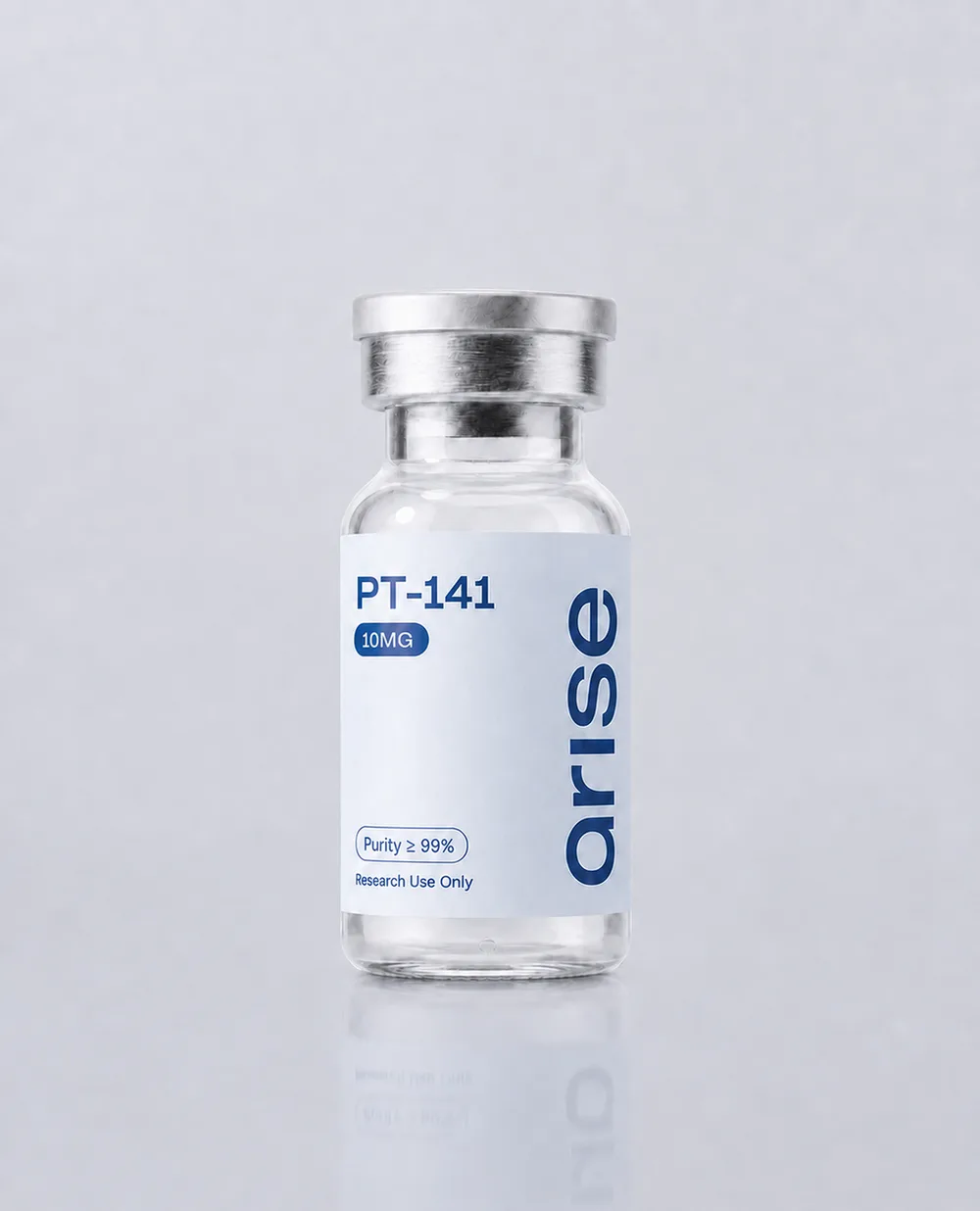
PT-141
Bremelanotide, cyclic heptapeptide analog.
Important research notice
Not for human consumption. This product is sold exclusively for research and educational purposes. It is not intended to diagnose, treat, cure, or prevent any disease.
This material is supplied exclusively as a research reagent for in vitro and laboratory use by qualified researchers. It is not a drug, dietary supplement, cosmetic, or medical device, is not intended for human or veterinary use, and is not intended to diagnose, treat, cure, or prevent any disease. No dosing, administration, therapeutic, or benefit claims are made or implied. Cited literature is provided for scientific reference only and does not constitute a representation of efficacy or safety in any subject.
By purchasing this product, you confirm that you are a qualified researcher and will use it in accordance with all applicable laws and regulations.