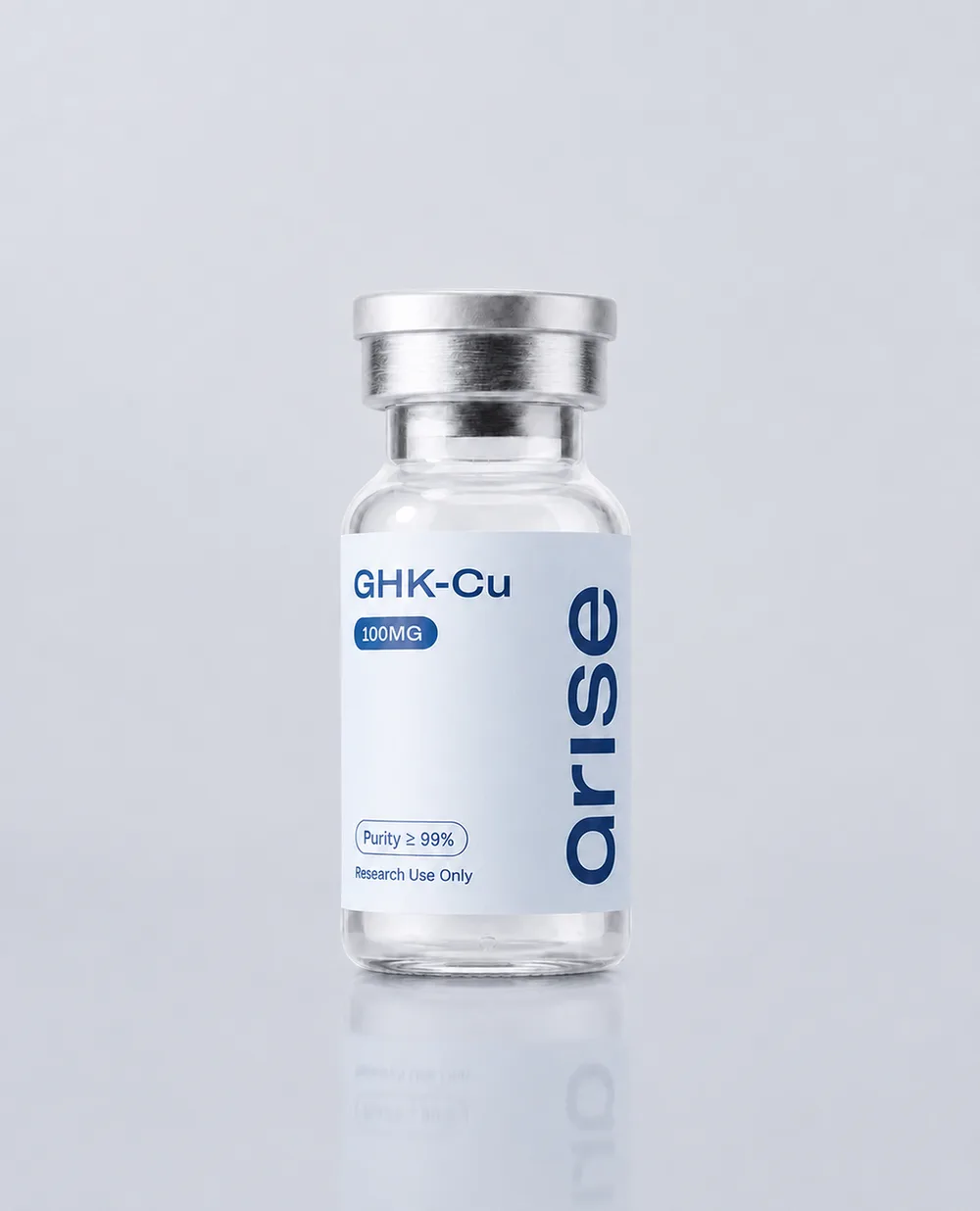
GHK-CU
100MGCopper(II) tripeptide-1 complex.
12 peer-reviewed citations for this compound
Read the sourcesVolume tiers count vials of this compound at this strength. Mixing different compounds does not combine toward a tier.
- ≥99% purity specification
- Secure checkout
- Ships in 1 business day
- Research use only
Released against a ≥99% HPLC purity specification and supplied as a sealed laboratory reagent for in vitro research use only.
- Type
- Copper(II) tripeptide-1 complex
- CAS number
- 89030-95-5
- Molecular weight
- 403.9 g/mol
- Amino acids
- 3
- Sequence
- Gly-His-Lys
- Form
- Lyophilized powder
- Vial strength
- 100MG
- Purity specification
- ≥99% by HPLC
Identifiers are published properties of the molecule. Values we cannot confirm are omitted rather than estimated.
Dispatch
Ships within 1 business day of order confirmation, from the US. Vials ship lyophilized at ambient temperature; move them to the storage condition below on arrival.
Lyophilized
Store at -20°C, protected from light. Stable 24+ months sealed.
Reconstituted
Store at 2-8°C. Use within approximately 30 days.
How GHK-CU is described to act.
GHK is a tripeptide (Gly-L-His-L-Lys) present in human plasma that forms a complex with Cu(II) with an affinity comparable to the copper transport site on albumin. The original characterization reported that the tripeptide readily forms copper(II) complexes and enhances uptake of the metal into cultured hepatoma cells, framing it as a copper transport factor rather than a receptor ligand. In dermal fibroblast culture, GHK-Cu is reported to raise MMP-2 mRNA and protein together with secretion of the tissue inhibitors TIMP-1 and TIMP-2, an effect reproduced by copper ions but not by the uncomplexed peptide. A 2024 murine study identified peroxiredoxin 6 as a direct binding target in alveolar macrophages.
Mechanistic descriptions summarize published in vitro and animal work. They are not a representation of efficacy or safety in any subject, and no administration guidance is given or implied.
The 1980 Nature report established copper complexation and facilitated cellular copper uptake as the proposed basis of activity, and noted that several tripeptides carrying a histidyl-lysyl linkage were nearly as active. Cell-culture work described modulation of extracellular matrix turnover by wound fibroblasts, indicating effects on both matrix component synthesis and matrix remodeling. Review literature catalogs reported actions in animal and in vitro systems including chemoattraction of macrophages and mast cells, suppression of free radicals, and increased expression of collagen, elastin, VEGF, FGF-2, and nerve growth factor. In a silica-exposed mouse model of silicosis, GHK-Cu bound peroxiredoxin 6 and attenuated alveolar macrophage oxidative stress, lung inflammation, and fibrosis without reported significant systemic toxicity. A randomized human study in 13 patients undergoing CO2 laser skin resurfacing used resolution of post-treatment erythema as its endpoint and found no statistically significant between-group difference on computer analysis or blinded evaluation. Formulation-focused reviews identify limited permeation of the hydrophilic tripeptide through the lipophilic stratum corneum as the central obstacle to topical delivery, and question whether current analytical methods are adequate to measure permeation of liposome-encapsulated GHK-Cu at all. A second review of topical GHK as an anti-wrinkle ingredient addresses the advantages and the unresolved problems of the GHK-Cu and palmitoylated derivatives together. In A375 human and B16 mouse melanoma lines, a combination of palmitoyl copper peptide with acetyl tyrosine increased tyrosinase activity and melanin production, a direction of effect opposite to the depigmenting profile often assumed for cosmetic peptides. In Caenorhabditis elegans, GHK-Cu was assessed against ageing-related endpoints with mitochondrial function and the DAF-16/SKN-1 pathways proposed as mediators. Rodent and zebrafish models extend the inflammation literature: a dextran sulfate sodium murine colitis model examined SIRT1/STAT3 signalling, and zebrafish larvae exposed to copper sulfate or lipopolysaccharide were used to examine acute inflammatory endpoints.
Sources & references
Cited literature is provided for scientific reference only and does not constitute a representation of efficacy or safety in any subject. All research findings presented are sourced from peer-reviewed journals and are provided for educational reference only.
- 01
- 02
- 03
- 04Topically applied GHK as an anti-wrinkle peptide: Advantages, problems and prospective
Mortazavi SM, et al. · Bioimpacts, 2025
- 05Palmitoyl copper peptide and acetyl tyrosine complex enhances melanin production in both A375 and B16 cell lines
Hong M, et al. · Biochem Biophys Res Commun, 2025
- 06
- 07
- 08The human tri-peptide GHK and tissue remodeling
Pickart L · J Biomater Sci Polym Ed, 2008
- 09Effects of topical copper tripeptide complex on CO2 laser-resurfaced skin
Miller TR, et al. · Arch Facial Plast Surg, 2006
- 10
- 11
- 12Growth-modulating plasma tripeptide may function by facilitating copper uptake into cells
Pickart L, et al. · Nature, 1980
Every entry links to its record at the publisher or on PubMed. Titles are reproduced exactly as published.
Further searches
Live database searches for GHK-CU, run against the current index and retrieved independently of this site.
Bench handling, not a dosing guide.
Intended use
Supplied exclusively as a research reagent for in vitro and laboratory use by qualified researchers. Not a drug, dietary supplement, cosmetic or medical device, and not for human or veterinary use. No dosing, route or administration guidance is provided for any compound in this catalog.
Personal protection
Handle in a controlled laboratory environment with gloves and eye protection. Avoid generating or inhaling airborne particulate when opening a vial, and do not handle the material outside a designated work area.
Copper complex
A copper(II) complex — reconstituted material is visibly blue. Keep buffers free of chelating agents such as EDTA, which strip the copper from the tripeptide, and protect solutions from light.
Opening and reconstitution
Lyophilized peptides are hygroscopic. Let the sealed vial equilibrate to room temperature before opening so atmospheric moisture does not condense onto the powder. Reconstitute by directing diluent down the vial wall and swirling until dissolved — do not shake, which shears and foams the peptide.
Stability and aliquoting
Store at -20°C, protected from light. Stable 24+ months sealed. Store at 2-8°C. Use within approximately 30 days. Aliquot reconstituted material and minimize repeated freeze-thaw cycles.
Waste disposal
Dispose of unused material, reconstituted solutions and sharps through your institution's chemical and biological waste stream, in accordance with local regulations. Do not dispose of research material in domestic waste or to drain.
Important research notice
Not for human consumption. This product is sold exclusively for research and educational purposes. It is not intended to diagnose, treat, cure, or prevent any disease.
This material is supplied exclusively as a research reagent for in vitro and laboratory use by qualified researchers. It is not a drug, dietary supplement, cosmetic, or medical device, is not intended for human or veterinary use, and is not intended to diagnose, treat, cure, or prevent any disease. No dosing, administration, therapeutic, or benefit claims are made or implied. Cited literature is provided for scientific reference only and does not constitute a representation of efficacy or safety in any subject.
By purchasing this product, you confirm that you are a qualified researcher and will use it in accordance with all applicable laws and regulations.